 Packetbrew
Mastering EIGRP: The Complete Guide to Cisco’s Enhanced Interior Gateway Routing Protocol
When it comes to enterprise networking, few routing protocols command as much respect as EIGRP. Cisco’s Enhanced Interior Gateway Routing Protocol has been the backbone of countless enterprise networks for decades, and for good reason. In this comprehensive guide, we’ll explore everything you need to know about EIGRP - from its core concepts to advanced configurations.
Why EIGRP Stands Apart from Other Routing Protocols
EIGRP is Cisco’s proprietary advanced distance-vector routing protocol, though it’s often called a “hybrid” protocol because it combines the best features of both distance-vector and link-state protocols. But what truly sets EIGRP apart is its intelligence and efficiency.
Unlike traditional distance-vector protocols that periodically broadcast their entire routing table to neighbors (regardless of whether anything has changed), EIGRP operates on a “need-to-know” basis. It only sends updates when network topology changes occur, making it incredibly efficient and scalable for large enterprise environments.
This efficiency is powered by the Diffusing Update Algorithm (DUAL), which guarantees loop-free routing while providing lightning-fast convergence times that can mean the difference between a minor network hiccup and a business-critical outage.
The Building Blocks of EIGRP
Neighbor Discovery: Building Relationships
EIGRP routers don’t just start exchanging routing information - they first establish formal relationships through a neighbor discovery process. Using Hello packets, routers introduce themselves to potential neighbors:
- High-speed links: Hello packets every 5 seconds by default
- Low-speed links: Hello packets every 60 seconds by default
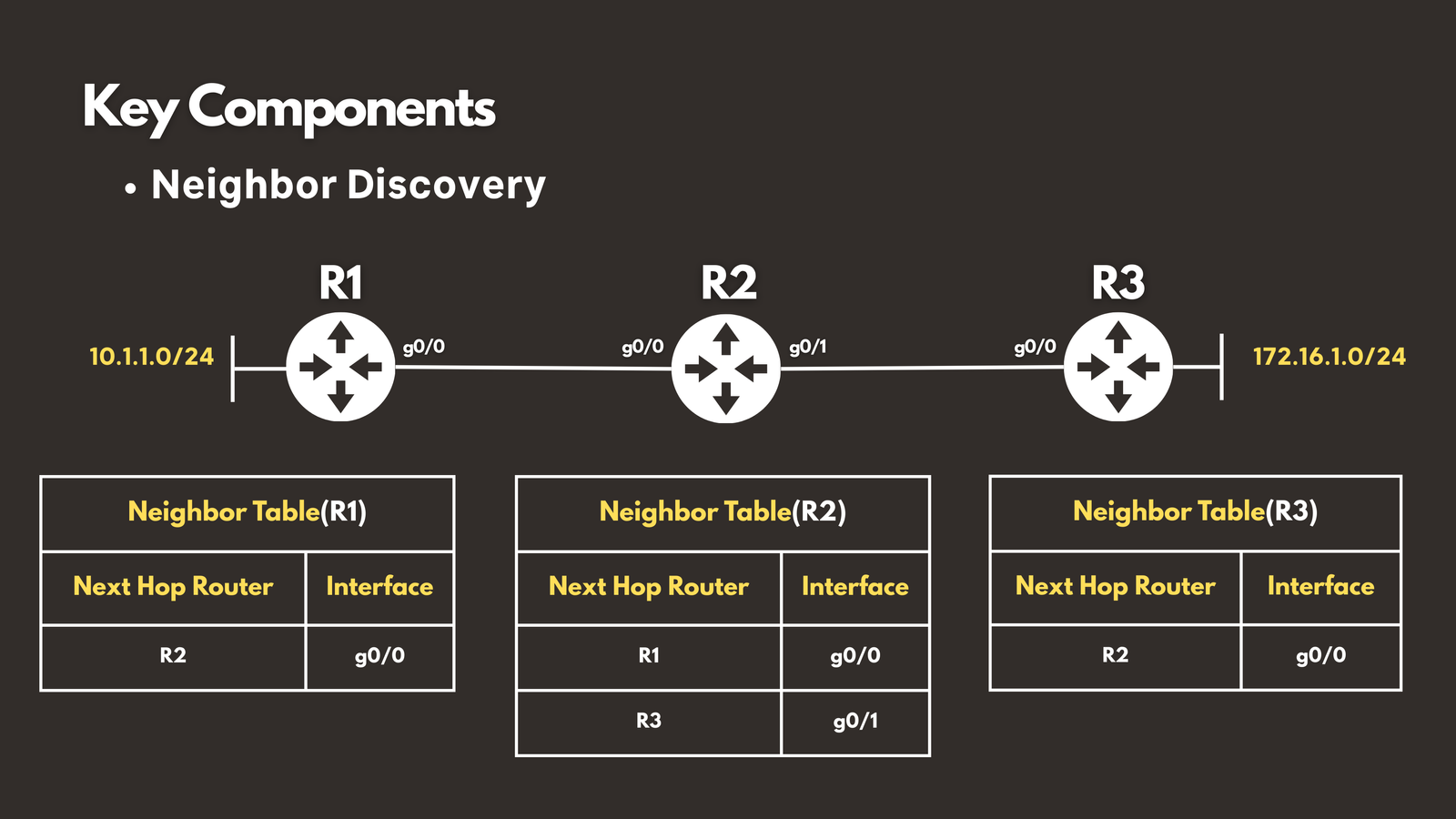 For routers to become neighbors, they must agree on two critical parameters:
- Autonomous System (AS) numbers: Must match exactly
- K-values: Metric calculation parameters that must be identical
The Topology Table: EIGRP’s Intelligence Center
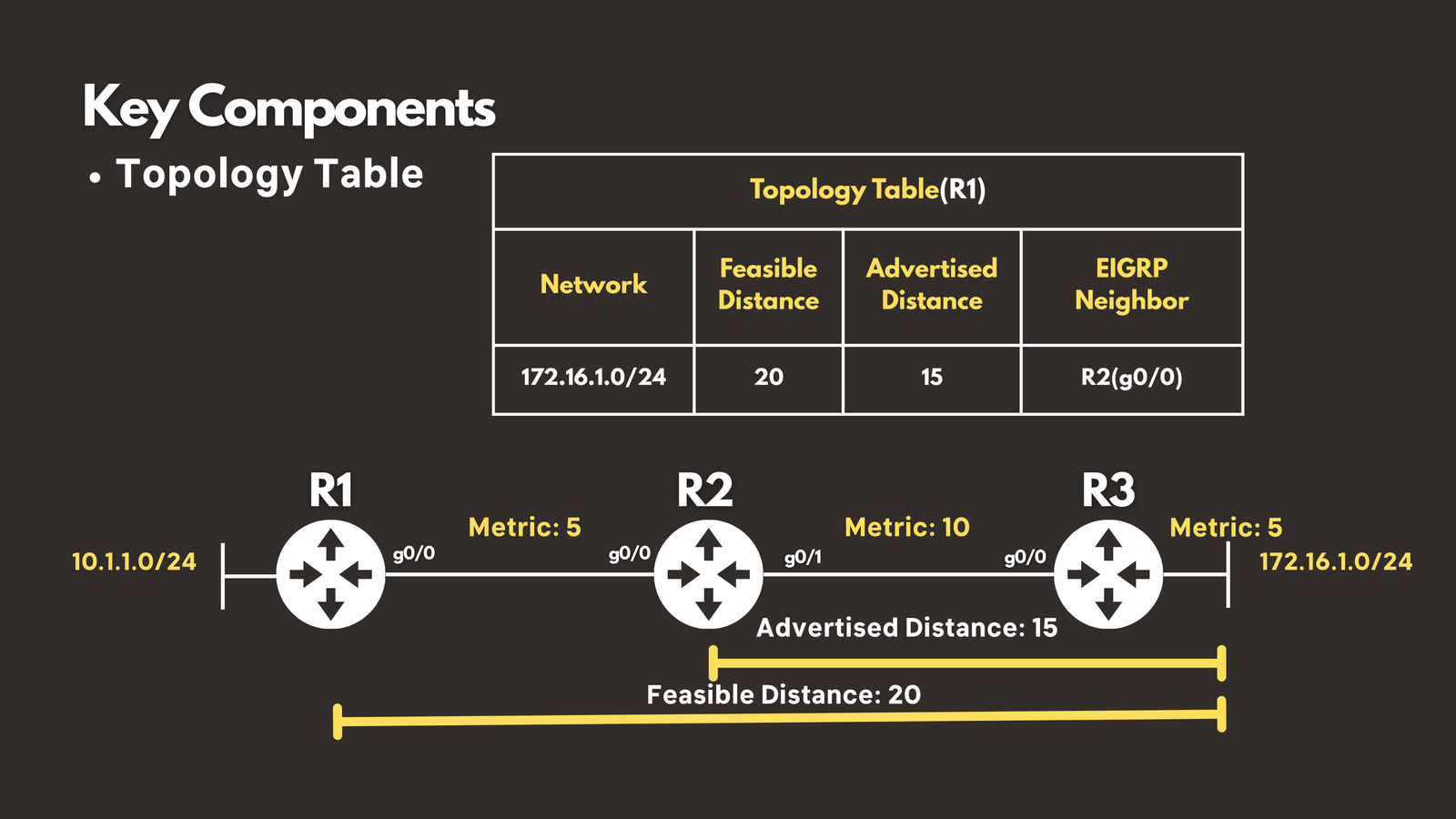
Each EIGRP router maintains a comprehensive topology table that goes far beyond what you’ll see in the routing table. This table contains ALL learned routes to destinations, not just the best ones. For each route, it tracks:
- Feasible Distance (FD): The metric from the local router’s perspective to reach a destination
- Advertised Distance (AD): The metric from the next-hop router to the destination
This comprehensive view allows EIGRP to make intelligent decisions about backup paths and fast convergence.
The Routing Table: Only the Best
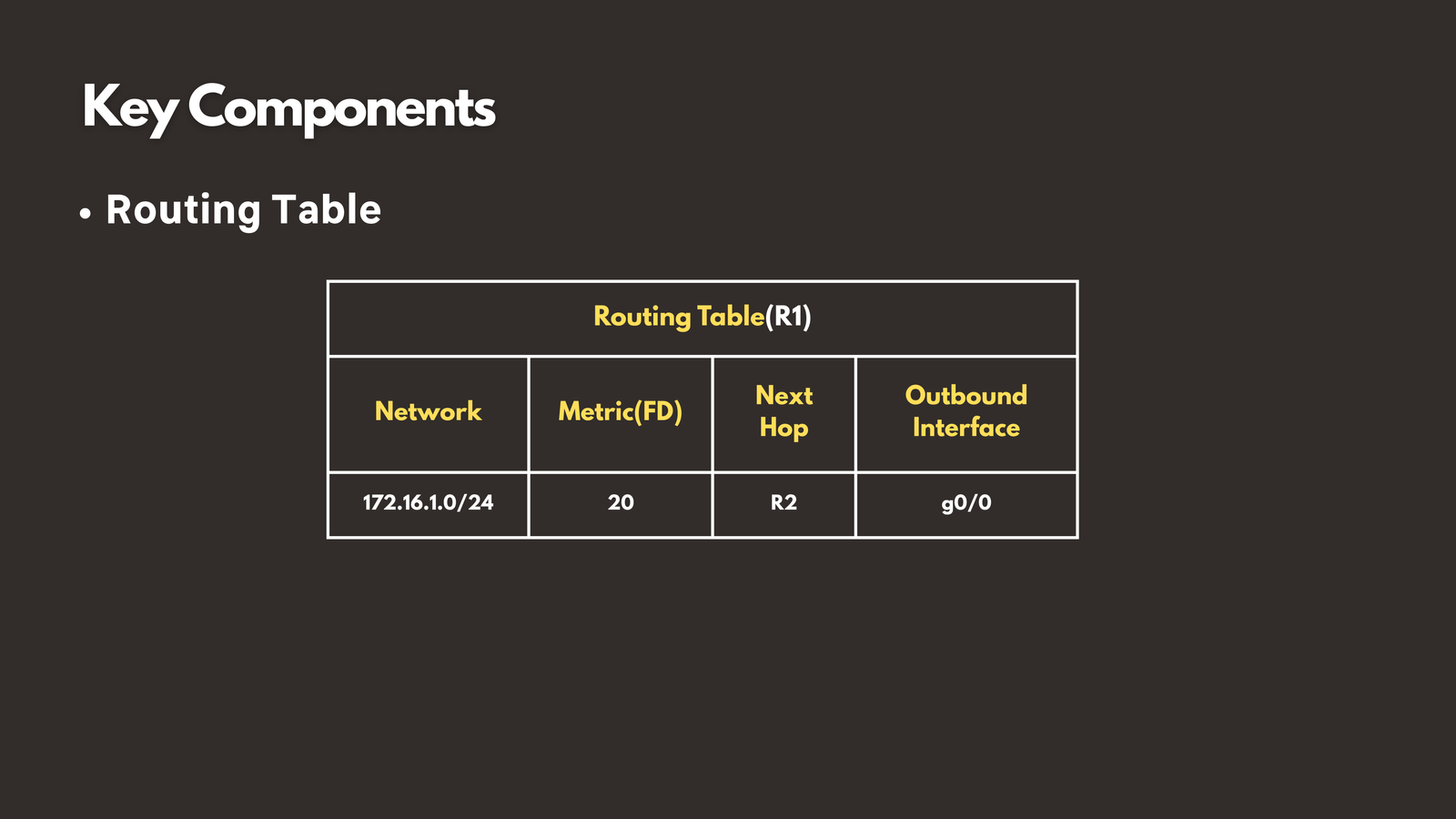
While the topology table contains all possible routes, the routing table contains only the best routes (called successors) that DUAL has determined to be loop-free and optimal.
DUAL Algorithm: The Brain Behind EIGRP’s Success
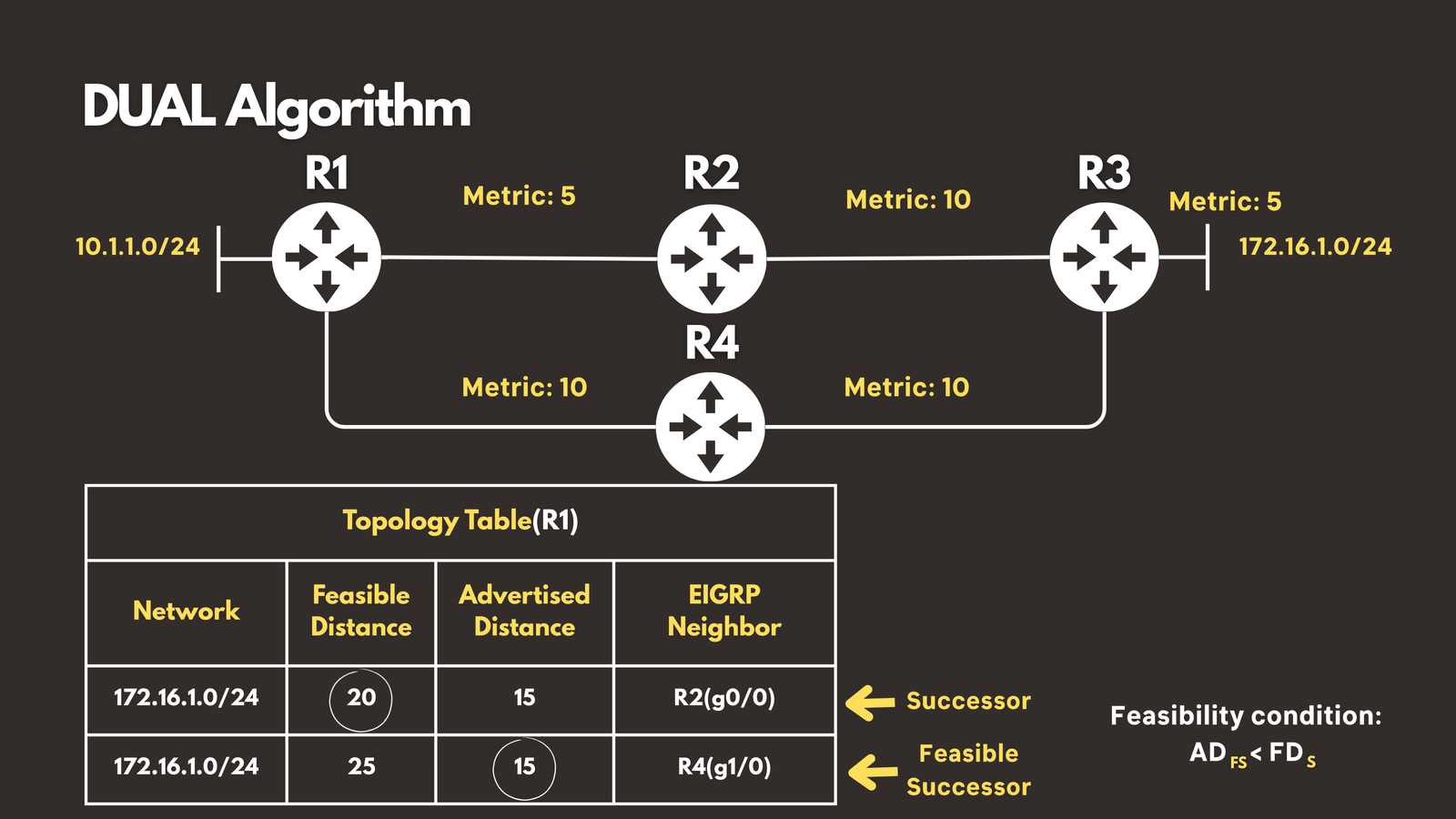
The Diffusing Update Algorithm is what makes EIGRP truly special. DUAL maintains two types of routes in its topology table:
Successor Routes
The successor is simply the best route to a destination - the one with the lowest metric that gets installed in the routing table.
Feasible Successor Routes
A feasible successor is a backup route that meets a specific mathematical condition called the feasibility condition. This condition states:
The Advertised Distance (AD) of the Feasible Successor must be lower than the Feasible Distance (FD) of the current Successor.
This mathematical relationship prevents routing loops by ensuring that any backup route couldn’t possibly create a loop back through the current router.
Why This Matters for Network Performance
When a primary route fails:
- If a feasible successor exists: Convergence happens in milliseconds
- If no feasible successor exists: EIGRP must query neighbors, taking longer but still typically sub-second
This pre-calculated backup approach is what gives EIGRP its reputation for extremely fast convergence.
EIGRP Metrics: How Routes Are Evaluated
EIGRP uses a sophisticated composite metric that considers multiple factors:
The Five Metric Components
- Bandwidth (most significant factor equals to 10^7 / minimum bandwidth)
- Delay(total delay expressed as tens of microseconds)
- Load (rarely used in practice)
- Reliability (rarely used in practice)
- MTU (carried but not used in calculations)
The Metric Formula
EIGRP uses K-values in its metric calculation:
metric = ([K1 × bandwidth + (K2 × bandwidth)/(256 - load) + K3 × delay] × [K5/(reliability + K4)]) × 256
However, by default, K2, K4, and K5 are set to 0, so the formula simplifies to:
Metric = (K1 × Bandwidth + K3 × Delay) × 256
In practical terms:
Metric = (10^7 / minimum bandwidth + total delay) × 256
This means EIGRP primarily considers the slowest link in the path and the cumulative delay.
EIGRP Packet Types: The Language of EIGRP
EIGRP uses five distinct packet types for communication:
- Hello - Neighbor discovery and keepalive
- Update - Routing updates
- Query - Asks neighbors about lost routes
- Reply - Response to queries
- ACK - Acknowledges reliable packets
Administrative Distance: EIGRP’s Trustworthiness Scale
EIGRP assigns different levels of trust to different types of routes:
- Internal routes: AD of 90 (very trustworthy)
- External routes: AD of 170 (less trustworthy than most IGPs)
- Summary routes: AD of 5 (highly trustworthy)
Why Network Engineers Choose EIGRP
- Lightning-Fast Convergence: When feasible successors exist, EIGRP can converge in milliseconds. Even without feasible successors, convergence is typically sub-second.
- Exceptional Scalability: With proper network design, EIGRP scales beautifully to large enterprise environments.
- Bandwidth Efficiency: By sending updates only when changes occur, EIGRP minimizes network overhead.
- Advanced Load Balancing: EIGRP supports both equal-cost and unequal-cost load balancing, maximizing link utilization.
- Flexible Route Summarization: Automatic summarization at network boundaries, with manual summarization available anywhere in the network.
EIGRP Configuration Essentials
Getting EIGRP up and running is straightforward:
Basic Configuration Syntax
router eigrp <AS-number>
network <network-address>
no auto-summary
Practical Example
router eigrp 100
network 192.168.1.0
network 10.0.0.0
no auto-summary
The no auto-summary command is crucial in modern networks to prevent unwanted route summarization.
The Bottom Line: Why EIGRP Endures
Despite being a Cisco proprietary protocol, EIGRP has maintained its relevance in the networking world for good reason. It strikes an exceptional balance between simplicity and advanced features, making it ideal for organizations heavily invested in Cisco infrastructure.
EIGRP’s true strength lies not just in finding the best path to a destination, but in its ability to maintain loop-free backup paths ready for instant deployment. In an era where network downtime can cost businesses thousands of dollars per minute, this capability is invaluable.
Whether you’re preparing for your CCNA certification, designing an enterprise network, or troubleshooting routing issues, understanding EIGRP’s operation and capabilities is essential for any serious network professional.
Ready to Master EIGRP?
EIGRP represents decades of routing protocol evolution, combining the reliability of distance-vector protocols with the intelligence of link-state protocols. Its efficient operation, fast convergence, and robust feature set make it a cornerstone technology for enterprise networking.
For more networking insights and tutorials, subscribe to Packetbrew - where complex networking concepts become clear and actionable knowledge.
Looking to dive deeper into routing protocols? Checkout the video on this link https://youtu.be/VNtz1v6KpDo