 Packetbrew
Mastering RIP: The Ancient Protocol That’s Key to Understanding Modern Internet Routing
In the fast-paced world of network engineering, it’s easy to dismiss older protocols as irrelevant. However, understanding the Routing Information Protocol (RIP) – one of the oldest and simplest routing protocols – is actually crucial for mastering modern networking concepts. More surprisingly, RIP serves as the foundation for understanding BGP, the protocol that literally powers the entire internet.
Why RIP Still Matters in 2025
While RIP may seem ancient (it was formally documented in 1988), the concepts it introduces are fundamental to all routing protocols. Think of RIP as the training wheels that teach you balance before riding a professional racing bike. The distance-vector concepts you learn with RIP directly translate to understanding how BGP’s path-vector intelligence routes traffic between tech giants like Amazon, Google, and your ISP.
What Exactly is RIP?
RIP is a distance-vector routing protocol that operates on a beautifully simple principle. Imagine a neighborhood where everyone knows the best routes to various destinations, and every 30 seconds, neighbors chat over the fence sharing their knowledge. That’s essentially how RIP works – routers continuously share routing information with their directly connected neighbors.
The protocol uses hop count as its primary metric, where a “hop” represents passing through one router. The fundamental rule is straightforward: the best path to any destination is the one with the fewest hops.
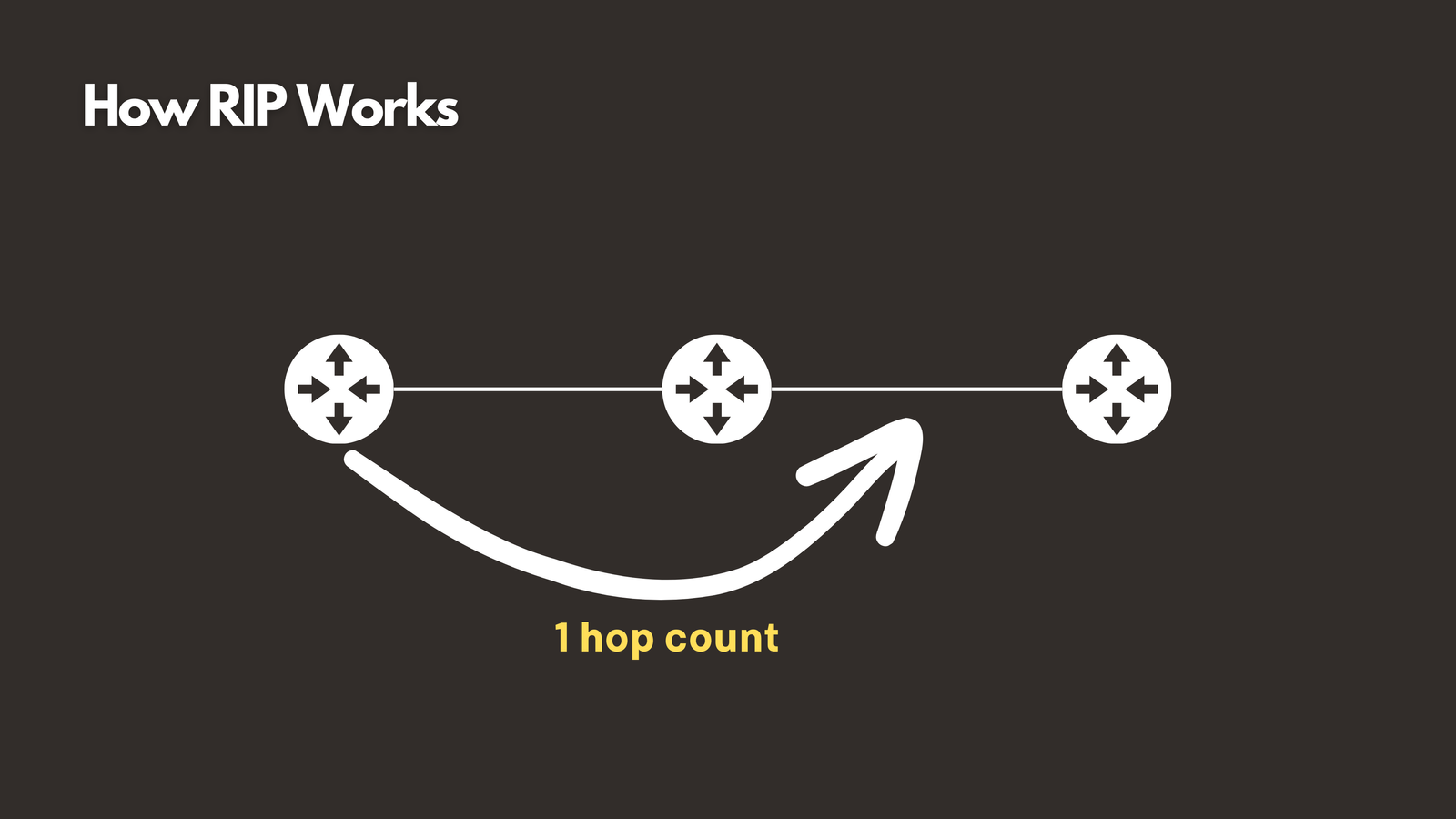
The RIP Process: From Isolation to Network-Wide Knowledge
When you first configure RIP on a network, here’s what happens:
Initial State: Each router begins knowing only about its directly connected networks – like a person who only knows their immediate neighborhood.
Information Sharing: Every 30 seconds, routers broadcast their complete routing table to all neighbors, similar to sharing your entire address book with friends.
Learning Process: When a router receives routing updates, it adds 1 to the hop count (accounting for itself) and updates its routing table if this represents a better path.
Network Convergence: Eventually, through this gossip-like process, all routers learn the optimal paths to reach every destination in the network.
Evolution Through Versions
RIPv1: The Original (1988)
The first version of RIP was relatively basic:
- Classful routing only: Could only work with major network classes (A, B, C)
- No subnet information: Couldn’t carry subnet mask details
- Broadcast updates: Sent information to all devices on the network segment
- No security: Lacked any authentication mechanisms
RIPv2: The Modern Upgrade (1998)
RIPv2 addressed many of RIPv1’s limitations:
- Classless routing support: Full CIDR (Classless Inter-Domain Routing) compatibility
- Subnet mask inclusion: Carried detailed subnet information
- Multicast updates: Used efficient multicast address 224.0.0.9
- Authentication support: Added security features
- Route tagging: Enabled advanced route management
The Art of Loop Prevention
One of RIP’s most important lessons involves preventing routing loops – a critical concept that applies to all routing protocols. RIP employs several elegant mechanisms:
Maximum Hop Count Limit
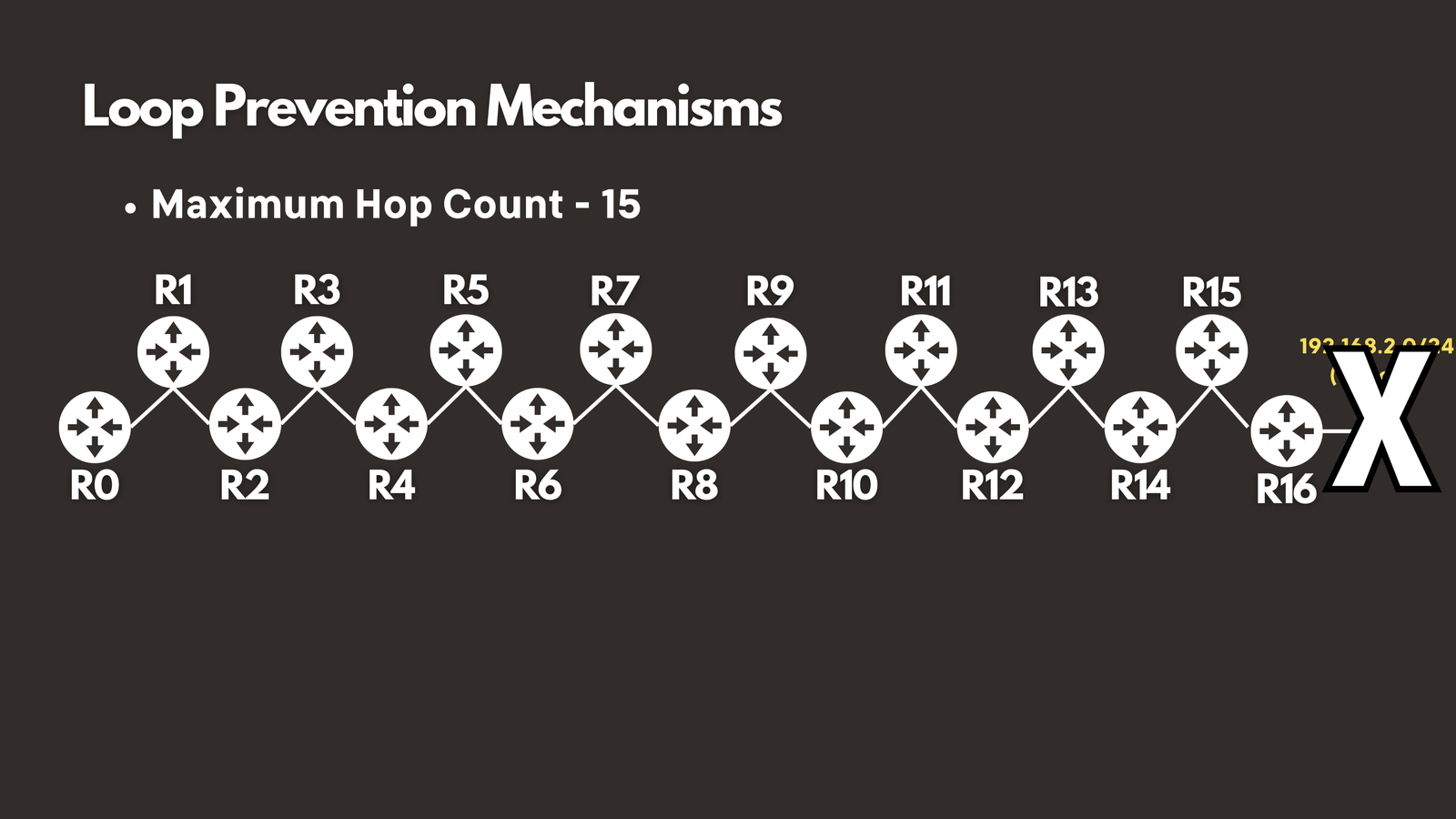
RIP restricts networks to a maximum of 15 hops, treating anything with 16+ hops as unreachable. While this limits scalability, it prevents infinite counting during loop scenarios.
Split Horizon
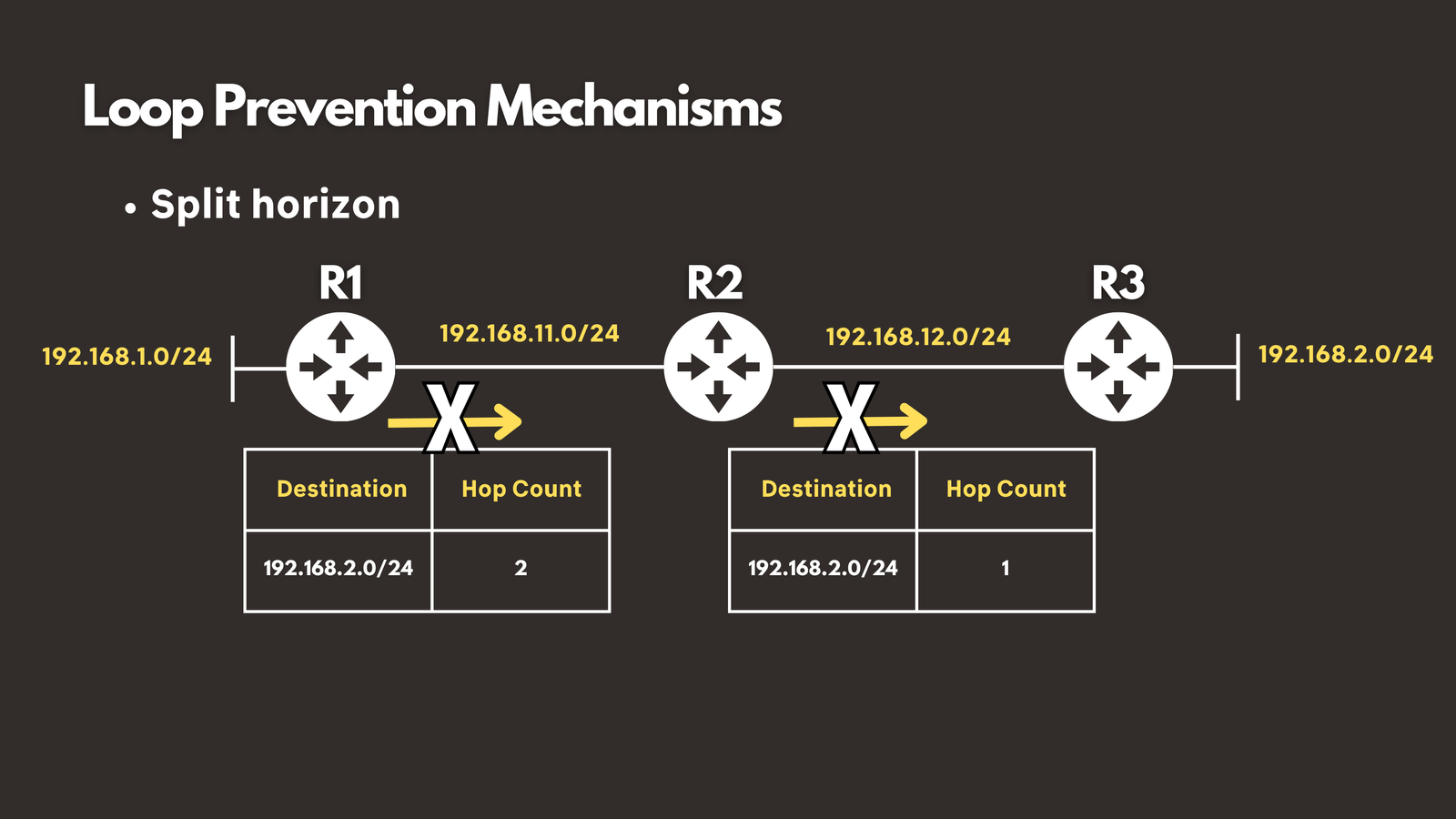
This rule prevents routers from advertising routes back through the interface where they learned them. If Router 1 learns about Network X(in this case 192.168.2.0/24) from Router 2, Router 1 won’t tell Router 2 how to reach Network X – preventing immediate loops.
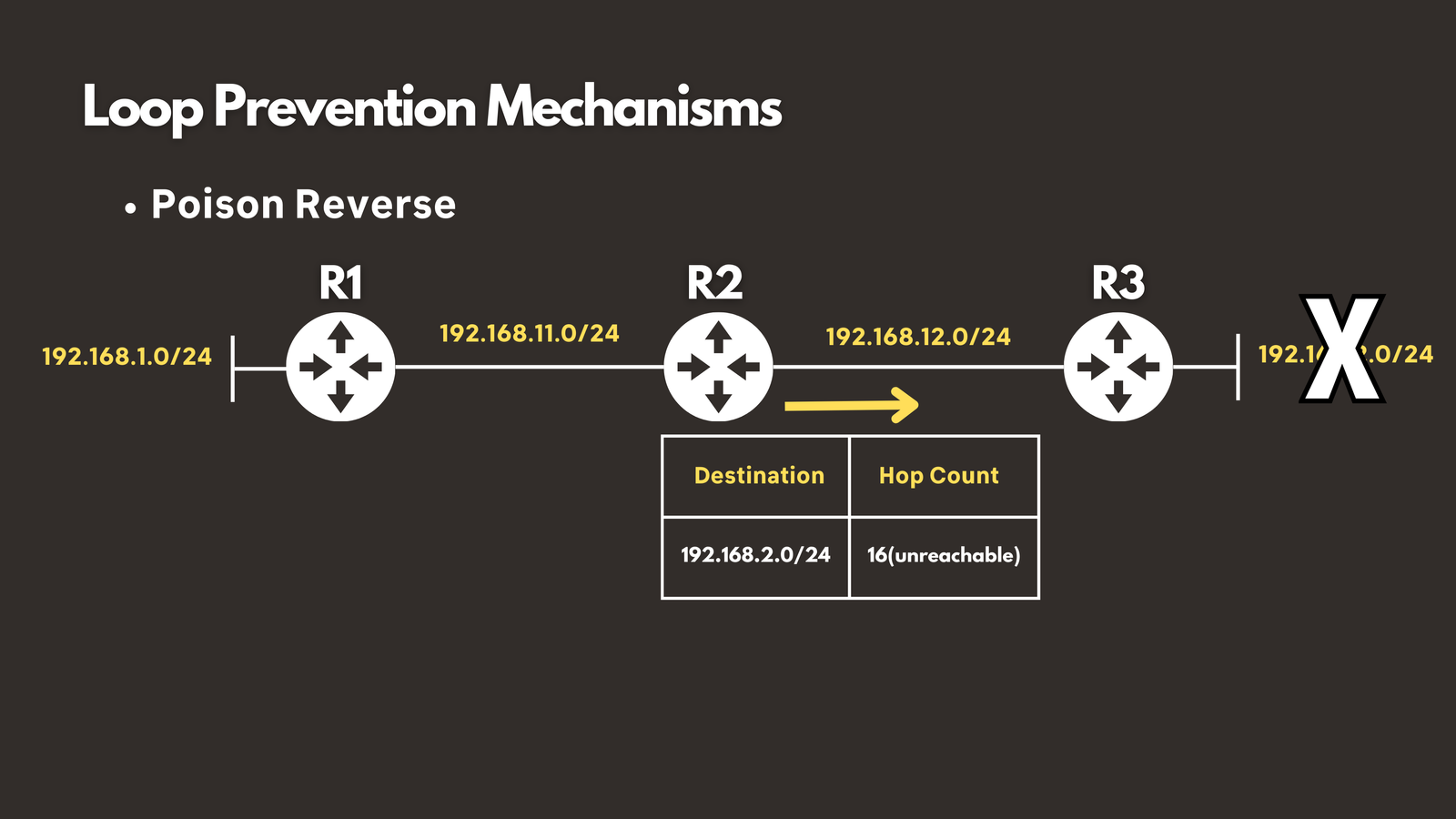
Route Poisoning and Poison Reverse
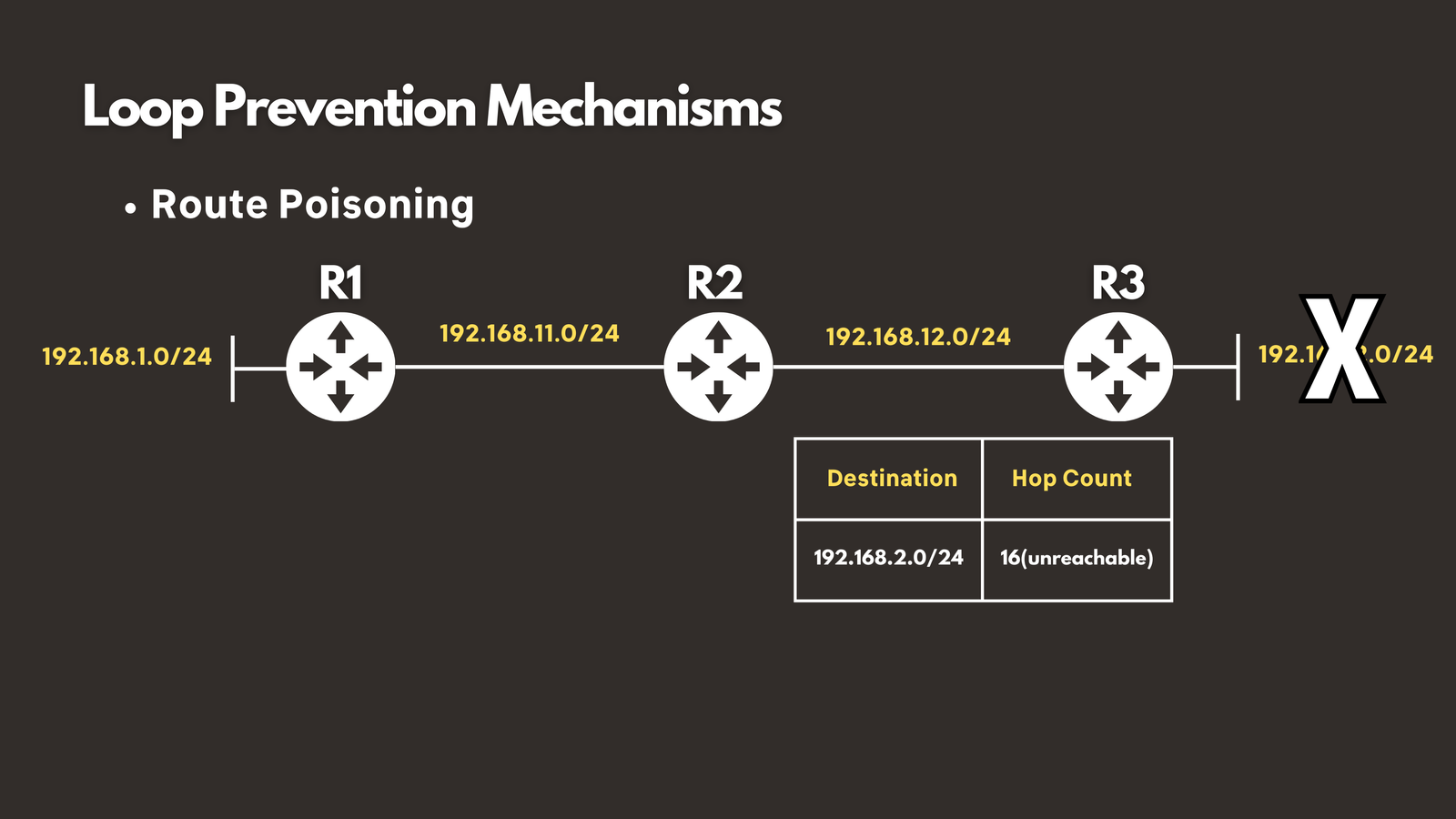
When a route becomes unavailable, RIP can “poison” it by advertising it with the maximum metric (16). Split Horizon with Poison Reverse goes further by actively advertising these poisoned routes back to the source, explicitly telling neighbors not to use this path.
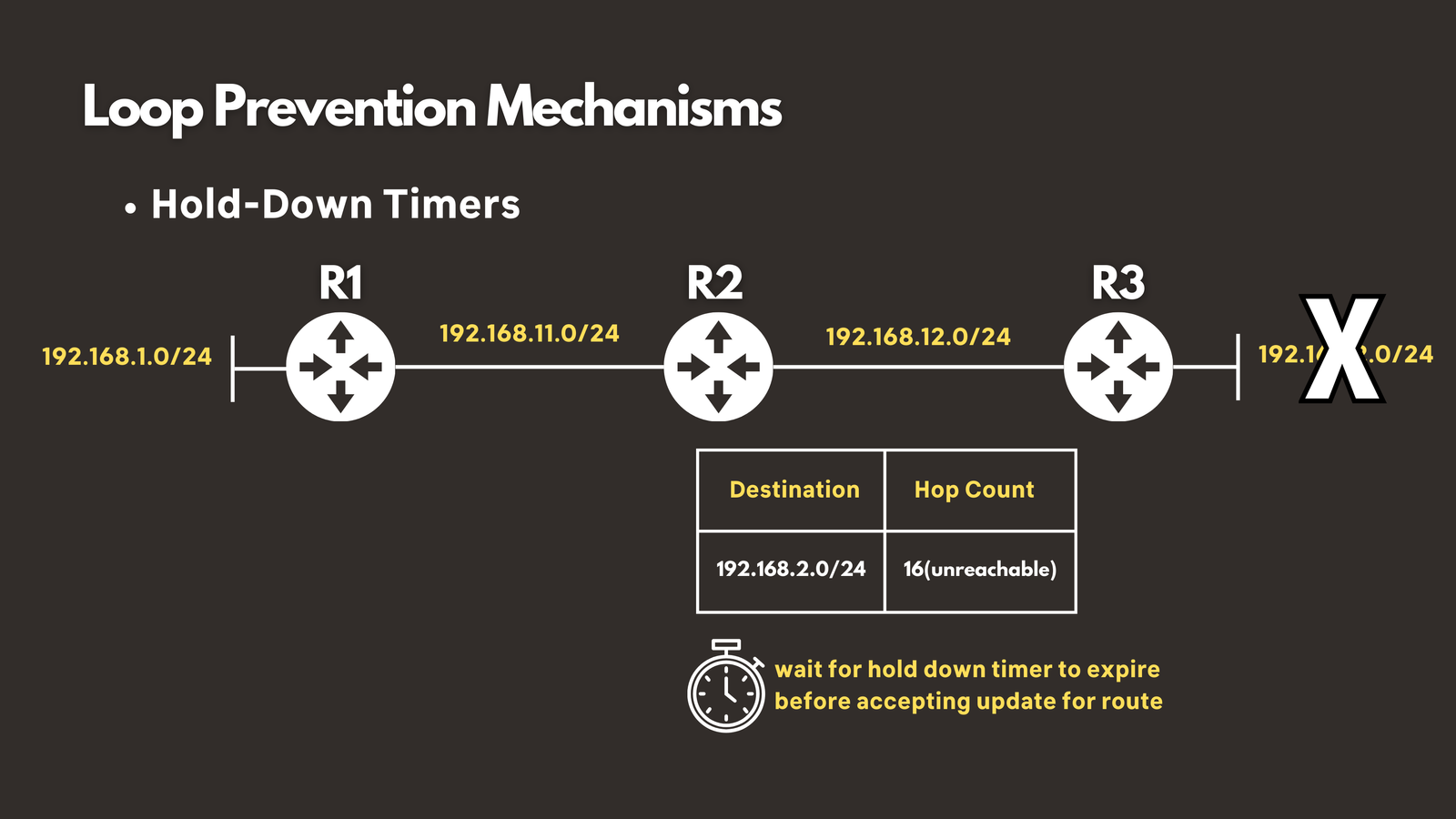
Hold-Down Timers
When a route fails, hold-down timers force routers to wait (180 seconds by default) before accepting new information about that destination. This prevents route flapping and hasty decisions during network instability.
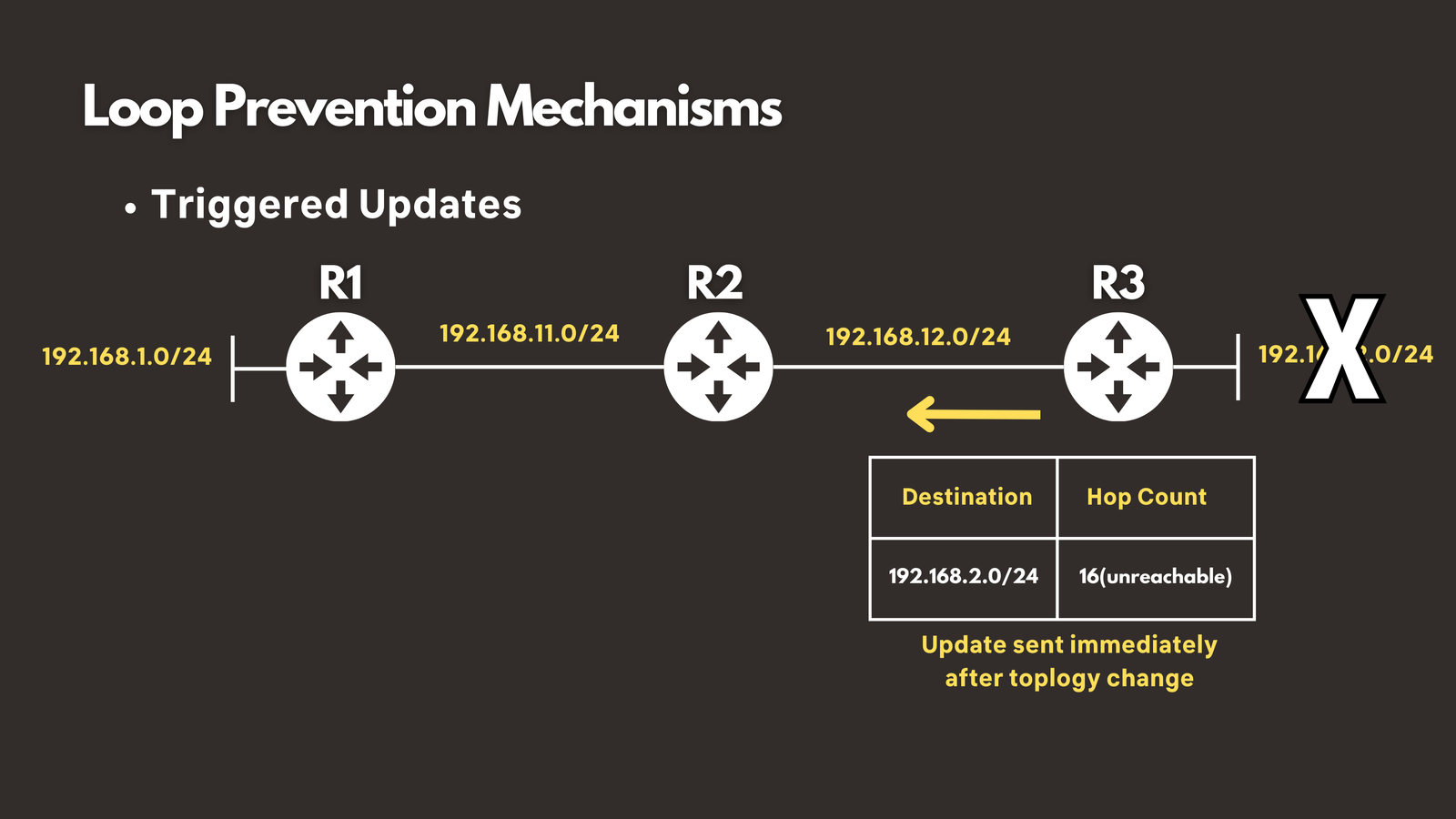
Triggered Updates
Available in RIPv2, this mechanism sends immediate updates when topology changes occur, rather than waiting for the next scheduled update cycle.
Understanding RIP Timers
RIP operates on a precise timing system:
- Update Timer (30 seconds): Regular routing table broadcasts
- Invalid Timer (180 seconds): Time before marking routes as suspect
- Hold-down Timer (180 seconds): Prevention period against route flapping
- Flush Timer (240 seconds): Complete route removal from the table
The Double-Edged Sword: Advantages vs. Disadvantages
Why Network Engineers Still Learn RIP
- Simplicity: Easy to configure and understand
- Automatic: Requires minimal manual configuration
- Standard: Well-documented RFC standard
- Small Networks: Perfect for simple topologies
The Reality Check: RIP’s Limitations
- Slow Convergence: Network changes can take several minutes to propagate
- Scalability Constraints: The 15-hop limit severely restricts network size
- Inefficient Metrics: Hop count ignores crucial factors like bandwidth, latency, and reliability
- Bandwidth Waste: Regular broadcasts consume network resources unnecessarily
- Loop Vulnerability: Complex topologies can still experience count-to-infinity problems
The Fascinating BGP Connection
Here’s where RIP’s true educational value shines. The concepts you master with RIP directly evolved into BGP’s internet-scale routing:
RIP’s hop count sharing evolved into BGP’s AS path sharing
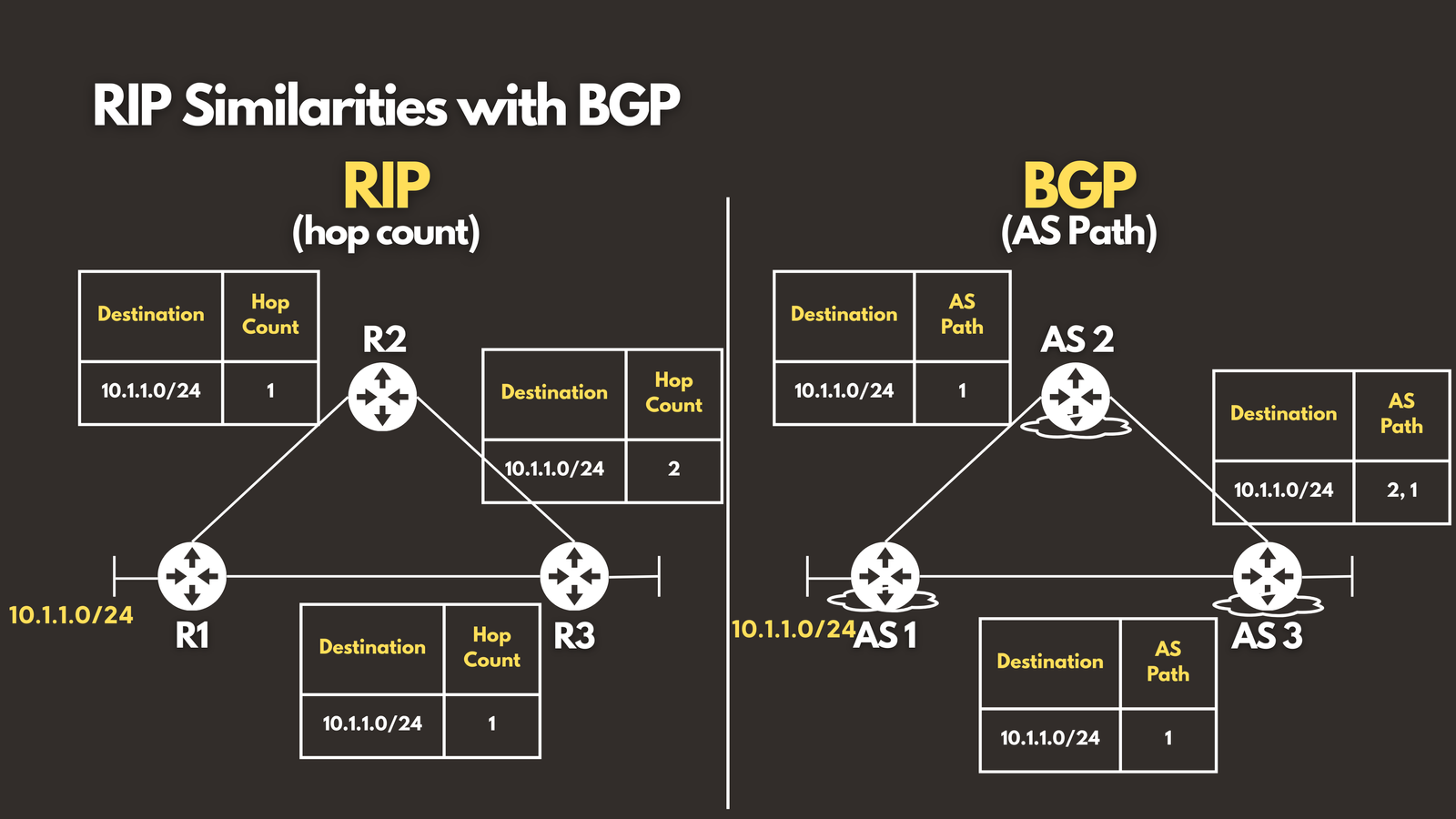
RIP’s split horizon loop prevention became BGP’s AS path loop detection
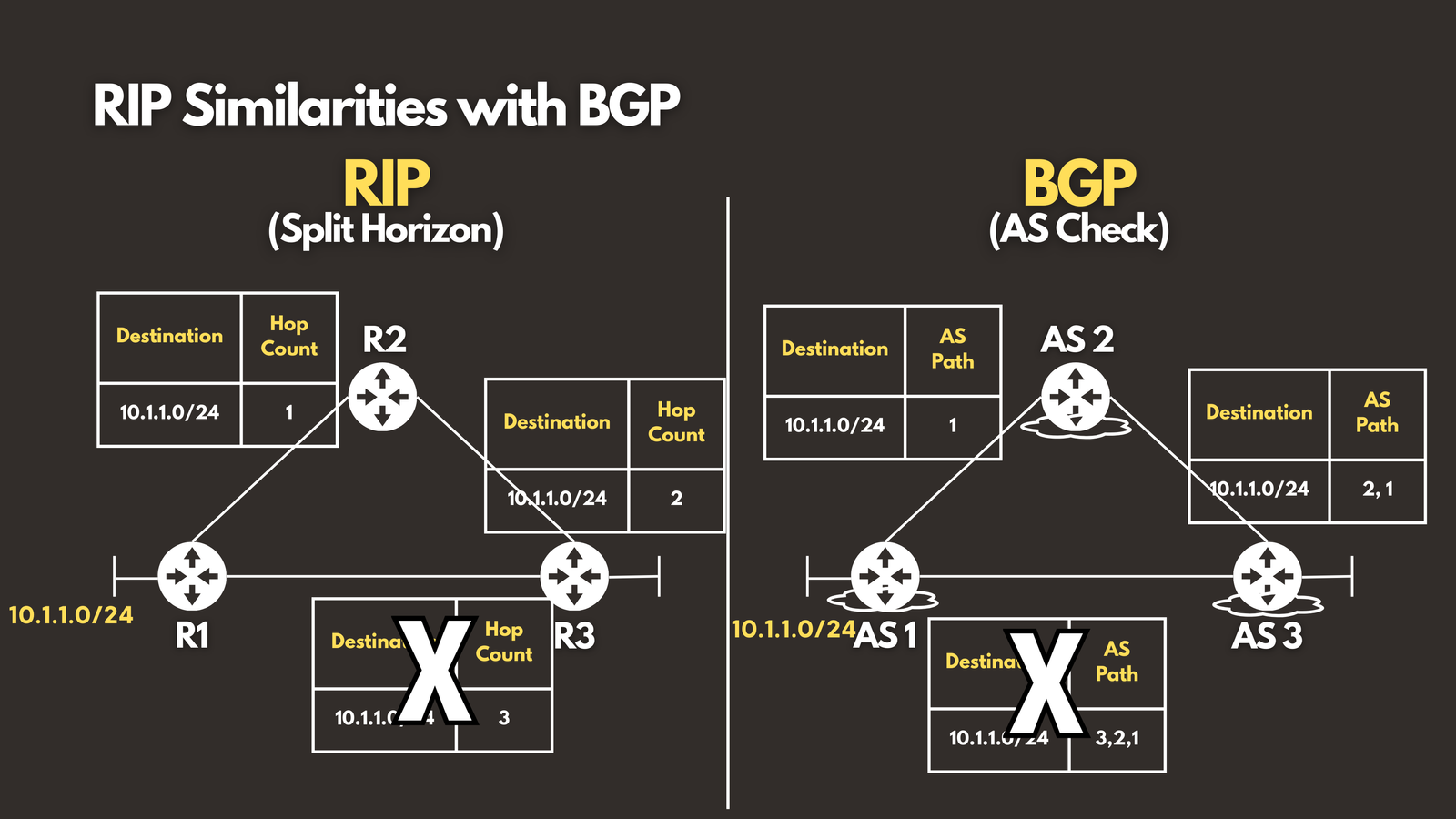
RIP’s periodic updates transformed into BGP’s persistent TCP sessions
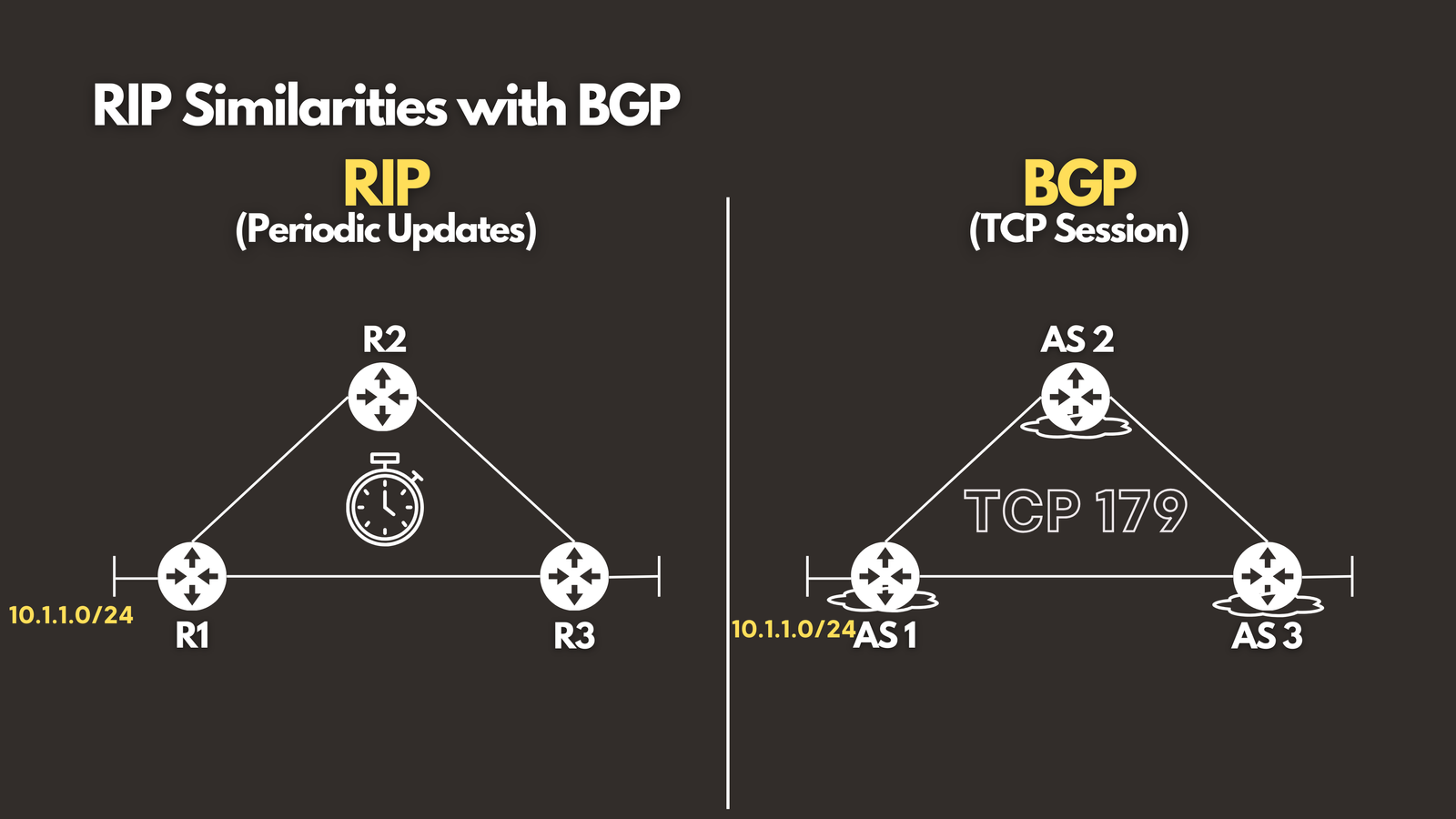
BGP essentially took RIP’s “tell your neighbors what you know” philosophy and added the sophistication needed to handle routing between thousands of autonomous systems across the global internet.
Practical Implementation: Configuration Made Simple
Setting up RIP is refreshingly straightforward. Here’s a basic configuration example for Cisco devices:
Router(config)# router rip
Router(config-router)# version 2
Router(config-router)# network <network address>
Router(config-router)# no auto-summary
This simple configuration:
- Enables RIP on the router
- Sets the version to RIP version 2
- Includes the network in RIP advertisements
- Disables automatic summarization for more precise routing
The Learning Path Forward
Understanding RIP provides the conceptual foundation for all advanced routing protocols. It’s like learning basic arithmetic before tackling calculus – the fundamental principles remain constant even as complexity increases.
Whether you’re preparing for CCNA certification, studying for network engineering interviews, or simply wanting to understand how the internet works, RIP offers invaluable insights into the core principles that govern all network routing.
Conclusion: The Timeless Value of Fundamentals
RIP may be the bicycle of routing protocols – simple, reliable, and educational – but you wouldn’t use it to compete in Formula 1. However, just as professional race car drivers benefit from understanding basic driving principles, network engineers gain immense value from mastering RIP’s fundamental concepts.
The distance-vector logic, loop prevention mechanisms, and neighbor relationship concepts you learn with RIP provide the foundation for understanding OSPF’s link-state algorithms, EIGRP’s advanced distance-vector improvements, and BGP’s path-vector sophistication.
In our rapidly evolving technological landscape, sometimes the most valuable knowledge comes from understanding the foundations upon which everything else is built. RIP serves as that foundation for the routing protocols that keep our connected world functioning seamlessly.
Ready to dive deeper into network routing? Checkout the video on this link https://youtu.be/PkFxRmUgpgI