 Packetbrew
OSPF Routing Protocol Explained: The Complete Beginner’s Guide to Open Shortest Path First
Are you diving into the world of network routing and feeling overwhelmed by all the protocols? You’re not alone. Today, we’re breaking down OSPF (Open Shortest Path First) - one of the most critical routing protocols in modern networking that every IT professional should understand.
Whether you’re studying for your CCNA certification or starting your career in network engineering, this comprehensive guide will give you everything you need to master OSPF fundamentals.
What is OSPF? Understanding the Basics
OSPF stands for Open Shortest Path First, and it’s essentially the GPS system of computer networks. Just like your smartphone’s GPS finds the best route to your destination by analyzing traffic conditions and road availability, OSPF helps routers determine the optimal path for sending data across complex networks.
Key OSPF Characteristics:
- Link State Protocol: Routers share detailed information about their direct connections with all other routers in the network
- Shortest Path First: Uses the sophisticated Dijkstra Algorithm to calculate the most efficient routes
- Open Standard: Unlike proprietary protocols, OSPF works seamlessly with equipment from any vendor
Think of it this way: instead of asking random strangers for directions (like older protocols such as RIP), OSPF provides every router with a complete, real-time map of the entire network topology.
Why OSPF Dominates Enterprise Networks
OSPF has become the gold standard for enterprise routing, and for good reason. Here’s why network engineers choose OSPF over alternatives:
1. Lightning-Fast Convergence
When network changes occur - like a link failure or new router addition - OSPF quickly recalculates routes and updates the entire network. This means minimal downtime and seamless user experience.
2. Massive Scalability
OSPF can handle networks with thousands of routers without breaking a sweat. From small businesses to massive ISP infrastructures, OSPF scales beautifully.
3. Intelligent Load Balancing
Unlike simpler protocols, OSPF can simultaneously use multiple equal-cost paths, distributing traffic efficiently and maximizing network utilization.
4. Built-in Security
OSPF supports authentication mechanisms to prevent unauthorized routing updates, keeping your network secure from malicious interference.
5. Bandwidth Efficiency
OSPF only sends updates when actual changes occur, not periodic broadcasts. This conserves valuable network bandwidth.
Real-world comparison: While protocols like RIP are like using a paper road atlas from 1995, OSPF is like having Google Maps with live traffic updates, construction alerts, and alternative route suggestions.
How OSPF Works: The Three-Step Process
Understanding OSPF operation becomes simple when you break it down into three fundamental steps:
Step 1: Neighbor Discovery
Routers introduce themselves to directly connected neighbors using Hello packets. This is like neighbors waving to each other over the fence - establishing basic communication.
Step 2: Database Exchange
Each router shares comprehensive information about its links with every other router in the area, creating identical network topology databases. Everyone gets the same complete map.
Step 3: Route Calculation (SPF Algorithm)
Using the shared network map, each router independently calculates the shortest path to every possible destination using Dijkstra’s algorithm.
Cost Calculation: OSPF determines the “cost” of each path using the formula:
Cost = Reference Bandwidth(100Mbps by default) / Interface Bandwidth
Practical Example in Action
Let’s visualize this with a real scenario:
Router A needs to send data to Router E. After running OSPF calculations, it discovers two possible paths:
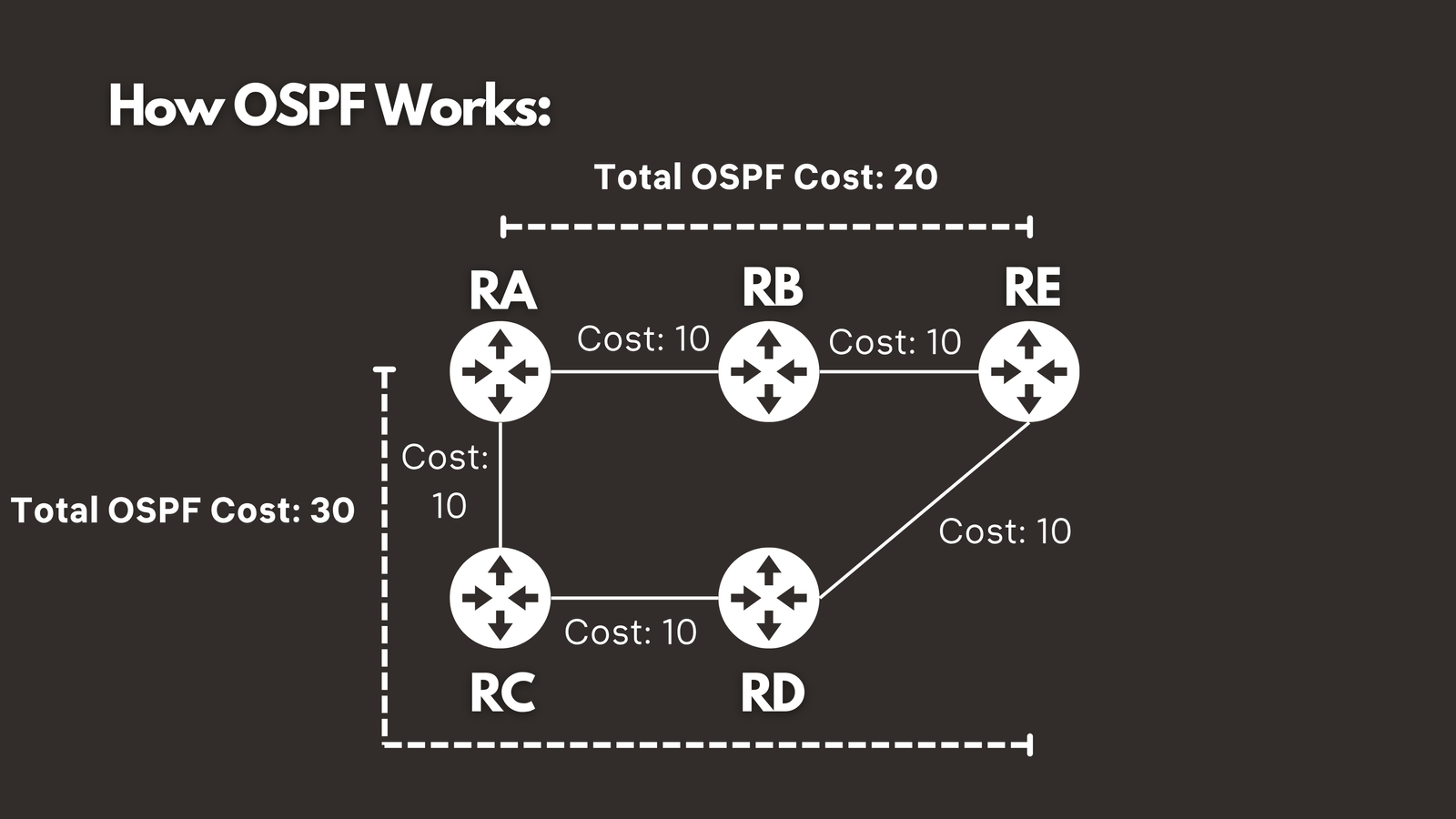
- Path 1: A → B → E (total cost: 20)
- Path 2: A → C → D → E (total cost: 30)
OSPF automatically selects Path 1 because it has the lower cost. If the A-B link fails, OSPF instantly detects the failure and seamlessly switches to Path 2 - all happening in seconds without human intervention.
Understanding OSPF Packet Types
OSPF uses five distinct packet types to maintain network awareness. While you don’t need to memorize every detail, understanding their purpose helps grasp the protocol’s elegance:
- Hello Packets: “Hey, I’m here!” - Discovers and maintains neighbor relationships
- Database Description (DBD): “Here’s what I know” - Summarizes link-state information
- Link State Request (LSR): “Tell me more about…” - Requests specific details
- Link State Update (LSU): “Here’s the complete info” - Contains actual topology data
- Link State Acknowledgment (LSAck): “Got it, thanks!” - Confirms successful receipt
Think of this as an organized conversation between neighbors sharing community information - polite, structured, and comprehensive.
OSPF Areas: Organizing Large Networks
One of OSPF’s most powerful features is its hierarchical area structure. This organization prevents networks from becoming unmanageably complex as they grow.
Area 0: The Backbone Area
- Central hub connecting all other areas
- Must exist in every OSPF network
- Like the interstate highway system connecting different regions
Regular Areas
- Connected to Area 0 through Area Border Routers (ABRs)
- Local traffic stays within the area when possible
- Like residential neighborhoods with local streets connecting to main highways
Why Use Areas?
Imagine if every person in New York City needed to memorize every single street in all five boroughs. That would be overwhelming and inefficient! Instead, you know your neighborhood intimately and understand how to reach major arteries that connect to other areas.
OSPF areas work identically - routers maintain detailed knowledge of their local area while keeping only summary information about distant areas. This approach dramatically improves:
- Network performance (less processing overhead)
- Convergence speed (localized changes don’t affect entire network)
- Troubleshooting (problems are contained and easier to isolate)
Essential OSPF Terminology
As you dive deeper into OSPF, you’ll encounter these key terms:
- LSA (Link State Advertisement): The actual network information packets shared between routers
- LSDB (Link State Database): Each router’s complete network topology map
- SPF Tree: The calculated shortest path structure to all destinations
- Designated Router (DR): On multi-access networks, the router coordinating LSA distribution
- Router ID: A unique identifier for each OSPF router (often the highest IP address)
Don’t worry if these terms seem overwhelming initially - they become intuitive as you gain hands-on experience with OSPF configuration and troubleshooting.
When Should You Use OSPF?
OSPF isn’t always the right choice for every network. Here’s when it shines and when simpler alternatives might be better:
OSPF is Perfect For:
- Medium to large networks (10+ routers)
- Enterprise corporate networks requiring reliability
- ISP and service provider infrastructures
- Multi-vendor environments needing interoperability
- Networks requiring fast convergence and high availability
- Complex topologies with multiple redundant paths
Consider Alternatives For:
- Very small networks (2-3 routers) where RIP might suffice
- Simple point-to-point connections not requiring dynamic routing
- Resource-constrained devices with limited processing power
- Networks where simplicity trumps advanced features
OSPF vs. Other Routing Protocols: Quick Comparison
| Feature | OSPF | RIP | EIGRP |
|---|---|---|---|
| Convergence | Fast | Slow | Fast |
| Scalability | Excellent | Poor | Good |
| Vendor Support | Universal | Universal | Cisco Only |
| CPU Usage | Moderate | Low | Low |
| Memory Usage | Higher | Low | Moderate |
| Best Use Case | Enterprise | Small Networks | Cisco Environments |
Real-World OSPF Implementation Tips
Based on years of network engineering experience, here are practical insights:
Design Best Practices:
- Keep areas reasonably sized (50-100 routers maximum per area)
- Use area 0 as transit only - don’t place end-user networks here
- Plan your addressing scheme before OSPF deployment
- Document your network topology thoroughly
Troubleshooting Common Issues:
- Check Hello timer mismatches between neighbors
- Verify area assignments are consistent
- Confirm subnet masks match on shared links
- Monitor Router ID conflicts that can cause adjacency problems
Taking Your OSPF Knowledge Further
Now that you understand OSPF fundamentals, here are your next steps:
Hands-On Practice:
- Download network simulators like Packet Tracer, GNS3, or EVE-NG
- Build lab topologies to experiment with OSPF configuration
- Practice troubleshooting scenarios to build confidence
- Join networking communities to learn from experienced professionals
Conclusion: Why OSPF Mastery Matters
OSPF isn’t just another protocol to memorize for certification exams - it’s the backbone of modern enterprise networking. Understanding OSPF gives you insight into how large-scale networks maintain reliability, performance, and scalability.
Whether you’re troubleshooting connectivity issues, designing network expansions, or optimizing performance, OSPF knowledge makes you a more effective network professional.
Key Takeaways:
- OSPF provides intelligent, automated routing for complex networks
- Its hierarchical area structure enables massive scalability
- Fast convergence and load balancing optimize network performance
- Universal vendor support makes it ideal for enterprise environments
- Hands-on practice is essential for mastering OSPF concepts
Ready to dive deeper into OSPF? Check out the video on this link https://youtu.be/vQAG8-pf_ms