 Packetbrew
AWS VPC Connectivity: A Guide to VPC Peering, Transit Gateway, and Hybrid Networking
Building applications in AWS often means working with multiple VPCs or connecting your cloud resources to on-premises data centers. Understanding your connectivity options is crucial for designing scalable, efficient network architectures. Let’s explore the key ways to connect your AWS infrastructure.
Understanding VPC-to-VPC Connectivity
When you need to connect multiple VPCs within AWS, you have two primary options: VPC Peering and Transit Gateway. Choosing the right one depends on your scale and complexity requirements.
VPC Peering: Simple Point-to-Point Connections
VPC Peering creates a direct connection between two VPCs, allowing them to communicate using private IP addresses. Think of it as building a private bridge between two networks.
Key characteristics of VPC Peering:
- Creates a one-to-one connection between exactly two VPCs
- Does not support transitive peering—if VPC 1 peers with VPC 2, and VPC 2 peers with VPC 3, VPC 1 cannot communicate with VPC 3 through VPC 2
- Requires non-overlapping IP address ranges between peered VPCs
- Supports cross-region peering for connecting VPCs in different AWS regions
- Best suited for scenarios with a small number of VPCs that need to connect
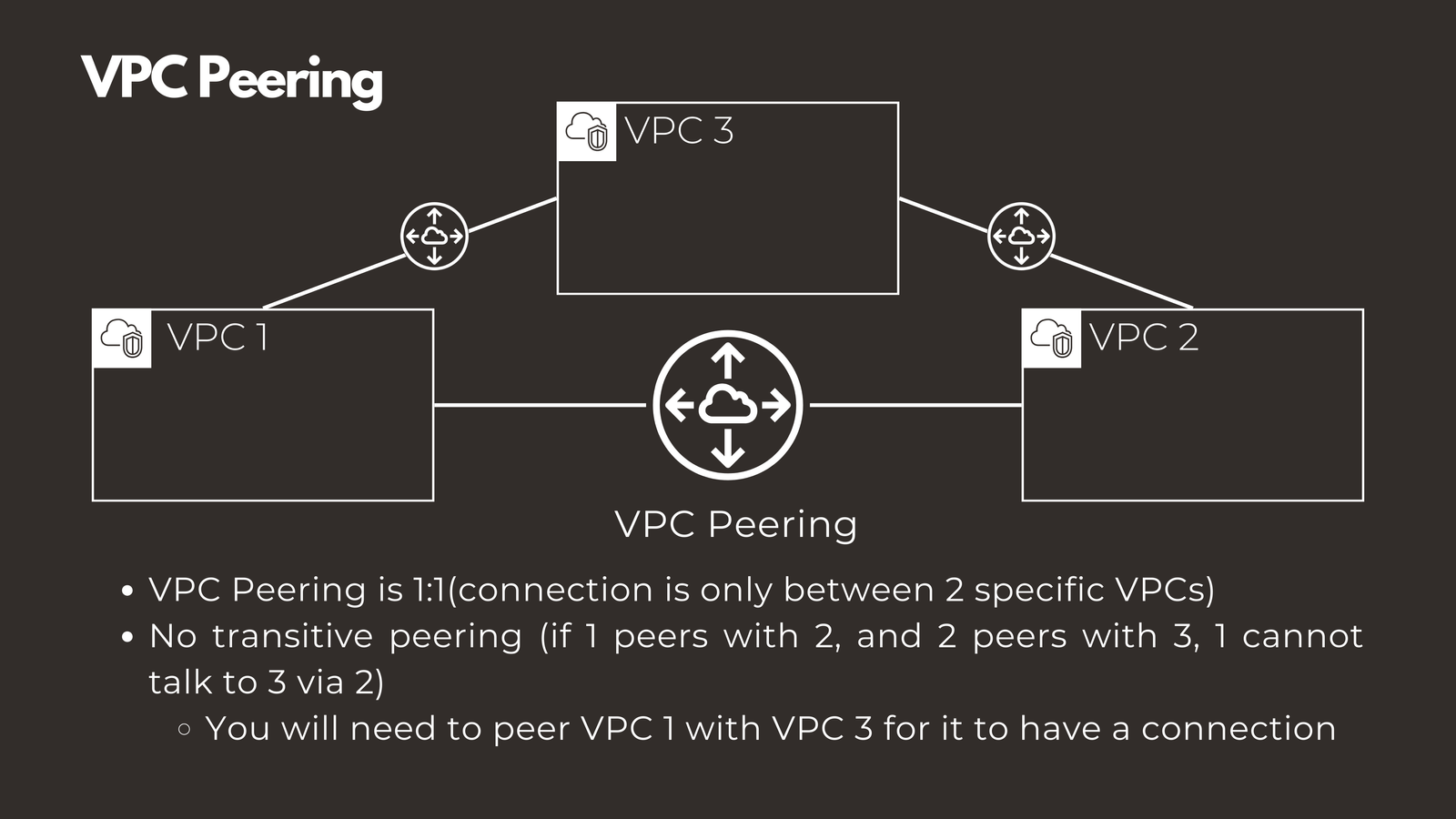
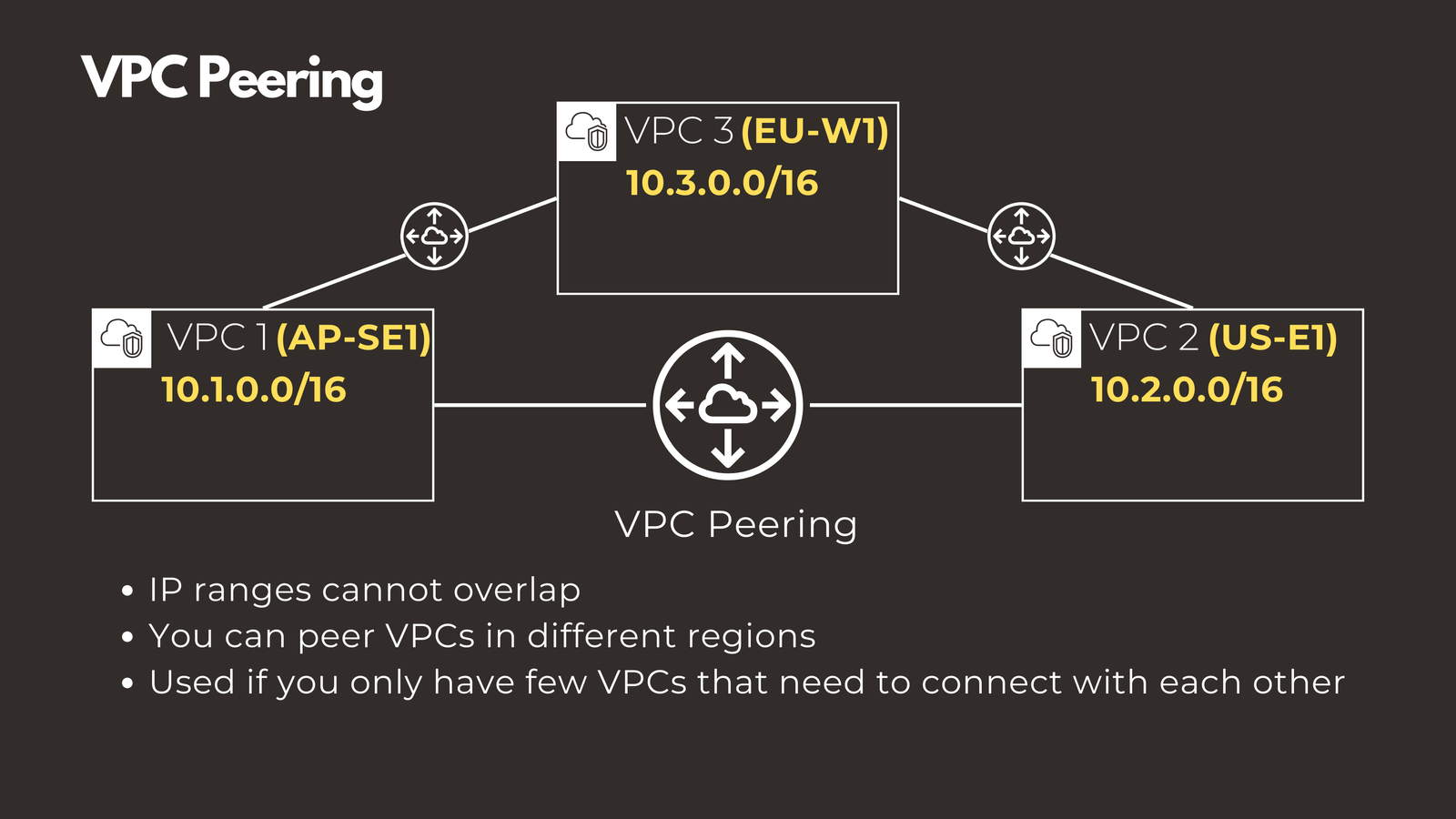
When to use VPC Peering: If you only have a handful of VPCs that need direct communication, VPC Peering offers a straightforward solution without additional infrastructure.
Transit Gateway: The Central Hub for Complex Networks
As your infrastructure grows beyond a few VPCs, managing individual peering connections becomes increasingly complex. Transit Gateway solves this problem by acting as a central hub that connects multiple VPCs and on-premises networks.
What makes Transit Gateway powerful:
- Functions as a regional router for your AWS infrastructure
- Can connect thousands of VPCs and on-premises networks simultaneously
- Supports multicast capabilities for one-to-many communication
- Provides traffic segmentation similar to VRFs (Virtual Routing and Forwarding) in traditional routers
- Operates within a single region but supports inter-region peering to connect Transit Gateways across different AWS regions
- Supports both BGP (Border Gateway Protocol) for dynamic routing and static route configuration
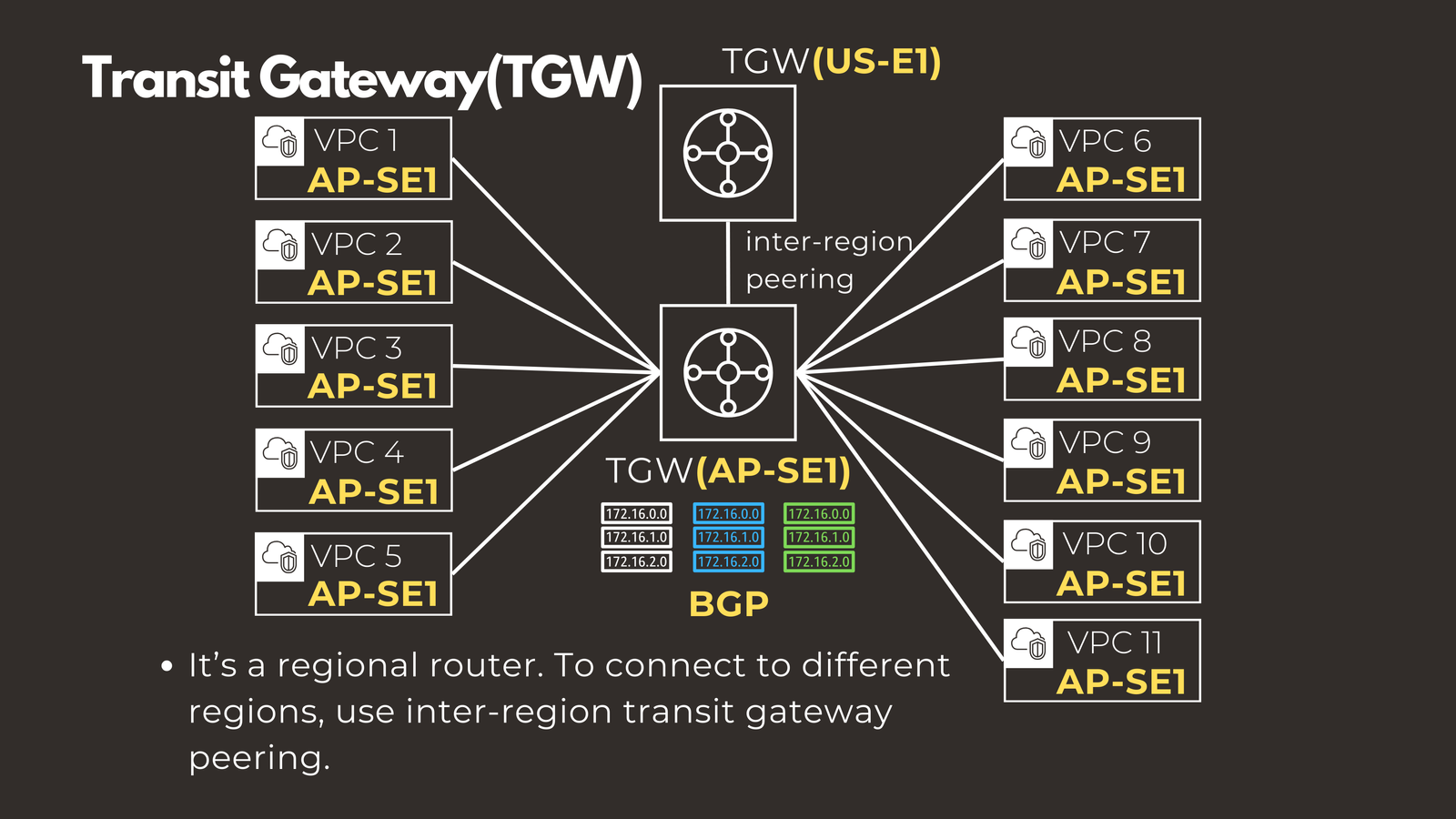
When to use Transit Gateway: If you’re managing multiple VPCs or need a scalable solution that can grow with your infrastructure, Transit Gateway is the modern, efficient choice.
Hybrid Networking: Bridging Cloud and On-Premises
Connecting your AWS VPCs to on-premises data centers requires different tools designed specifically for hybrid cloud architectures.
AWS Site-to-Site VPN: Secure Internet-Based Connectivity
AWS Site-to-Site VPN establishes an encrypted connection between your on-premises network and AWS VPCs over the internet using IPSec tunnels.
Components of Site-to-Site VPN:
- Virtual Private Gateway: The VPN endpoint on the AWS side of the connection
- Customer Gateway: Represents your on-premises VPN device
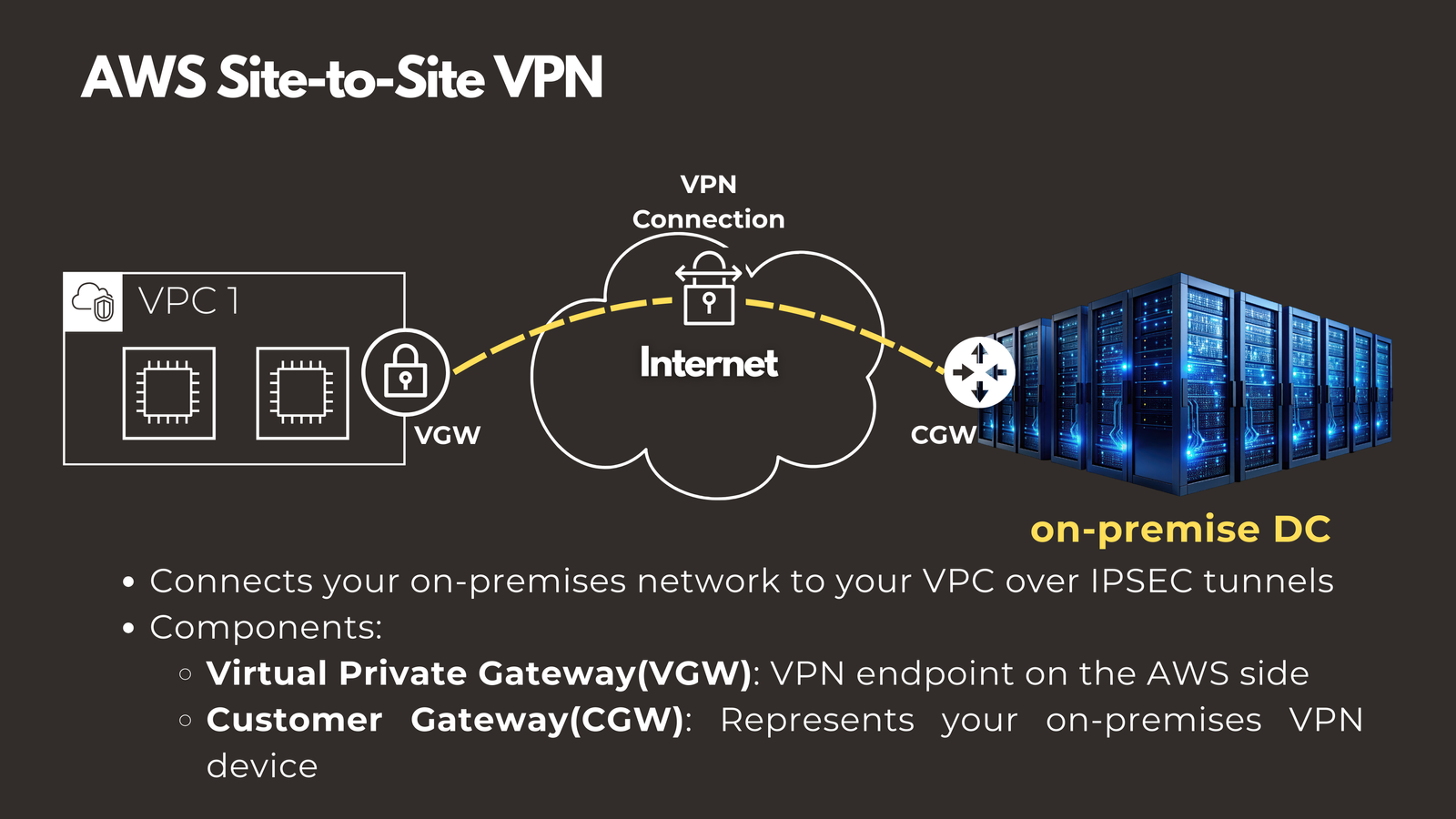
Considerations: While VPN provides secure connectivity, it relies on internet bandwidth and can be subject to latency and reliability issues inherent to public internet connections.
AWS Direct Connect: Your Private Highway to AWS
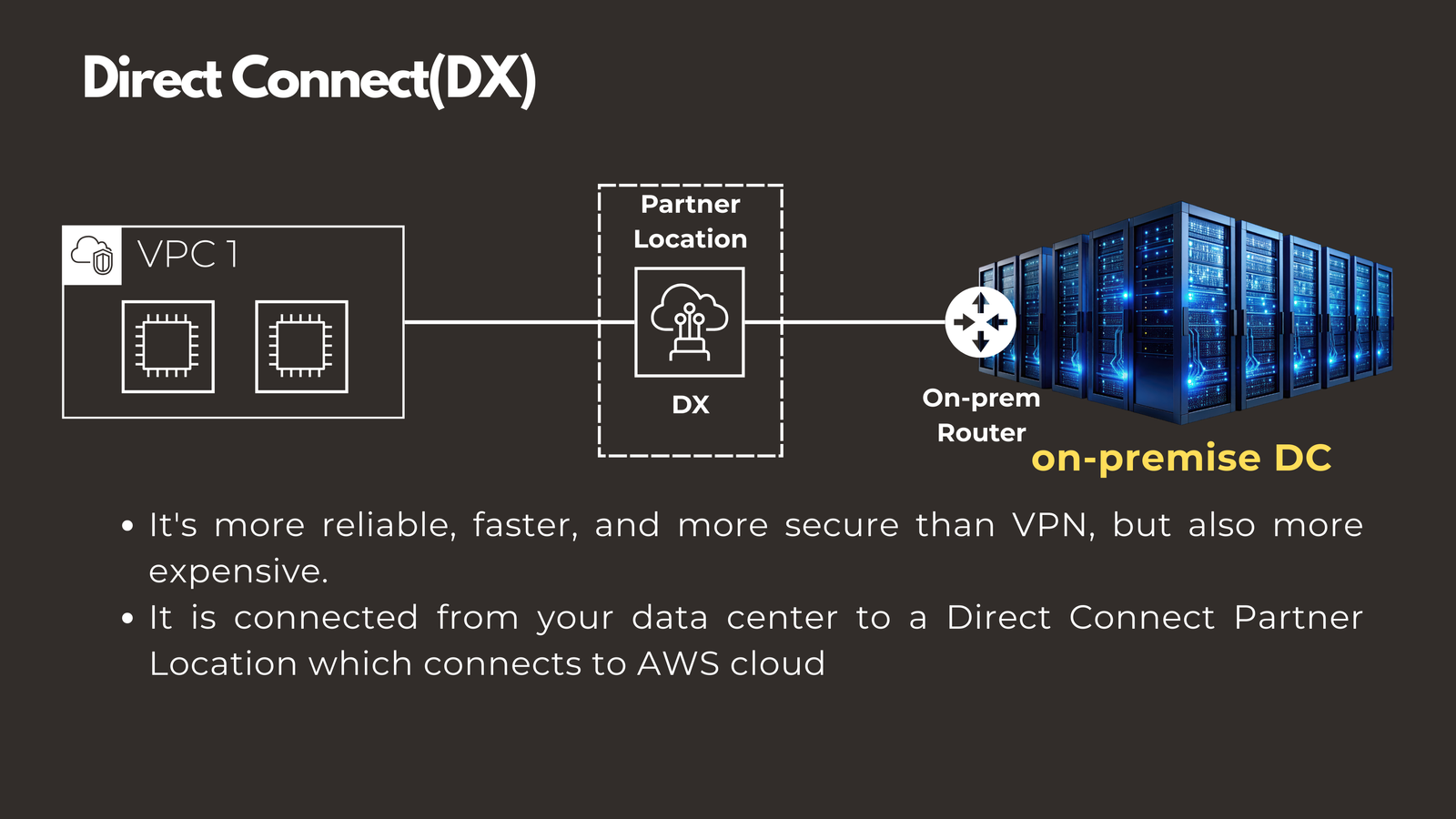
For organizations requiring consistent, high-performance connectivity, Direct Connect provides a dedicated private network connection between your data center and AWS.
Direct Connect offers several advantages over VPN:
- More reliable performance with consistent network speeds
- Enhanced security through a private connection
- Lower latency for latency-sensitive applications
- Higher throughput capabilities
How Direct Connect works: Your data center connects to a Direct Connect Partner Location, which then connects to the AWS cloud. The connection initially provides Layer 2 connectivity, and you configure Virtual Interfaces (VIFs) to enable communication with AWS services.
Understanding Virtual Interfaces (VIFs)
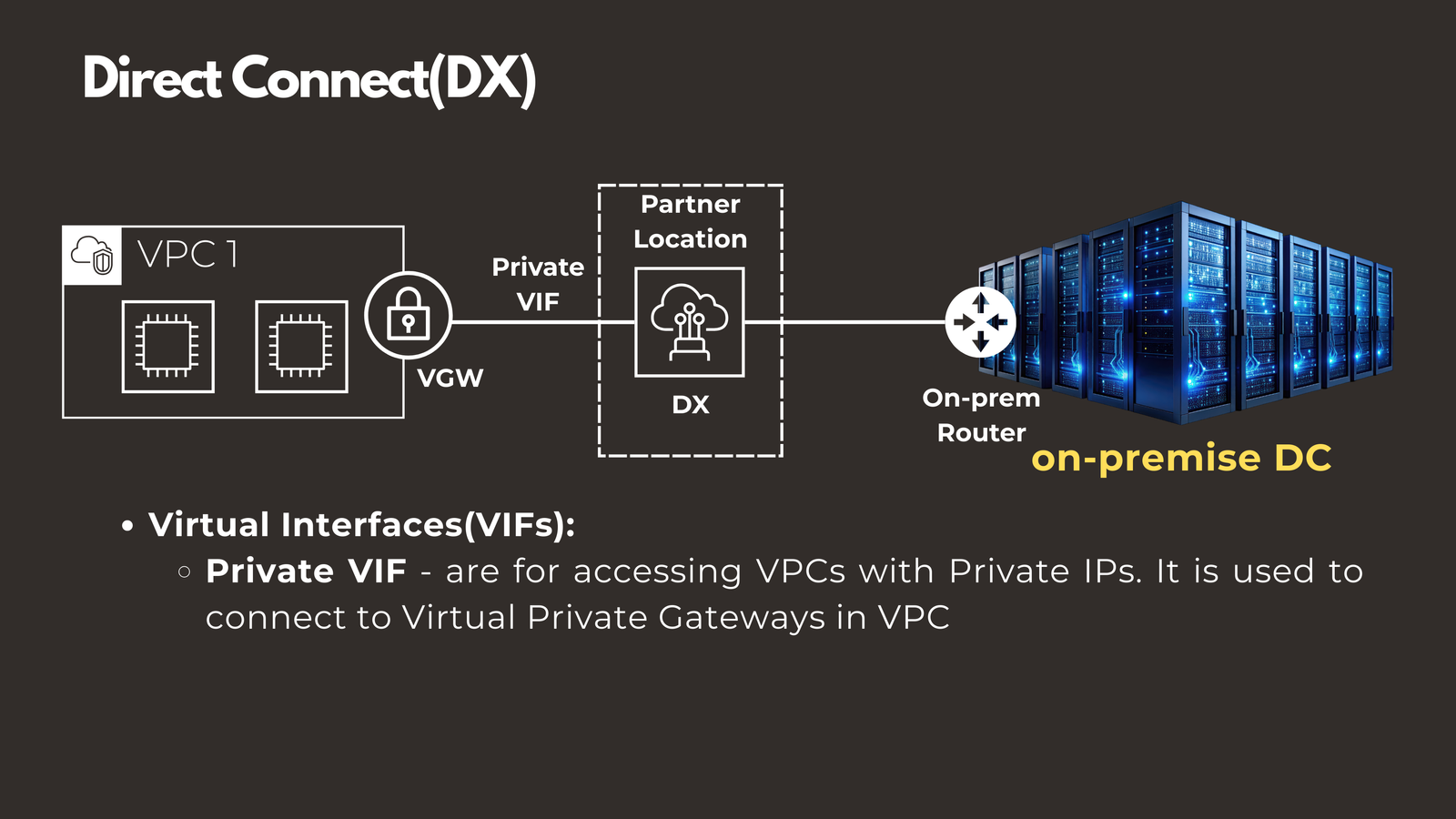
Direct Connect uses Virtual Interfaces to define what you can access through your connection:
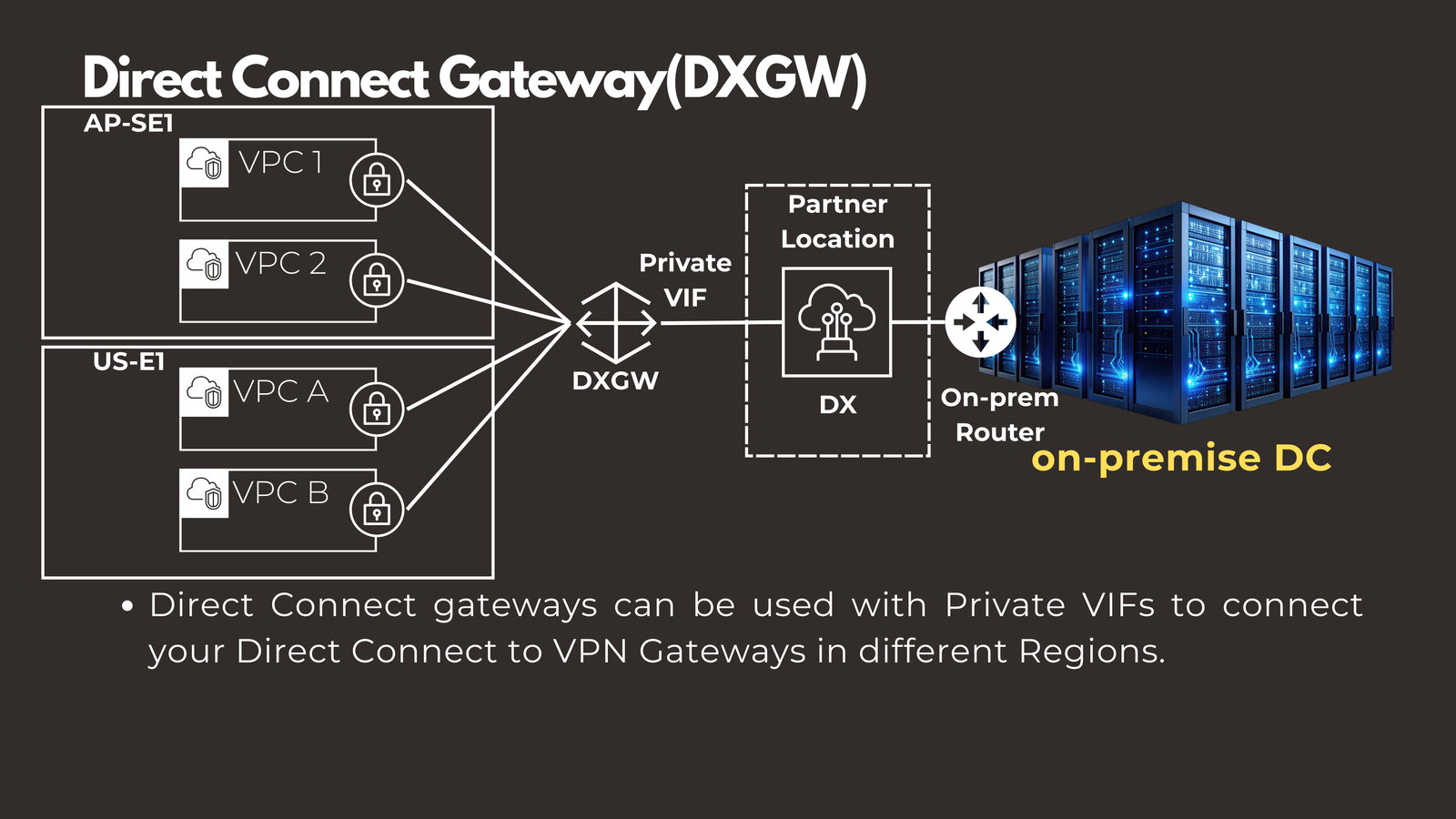
Private VIF: Connects to VPCs using private IP addresses. Use Private VIF to access Virtual Private Gateways in your VPCs, either directly or through a Direct Connect Gateway.
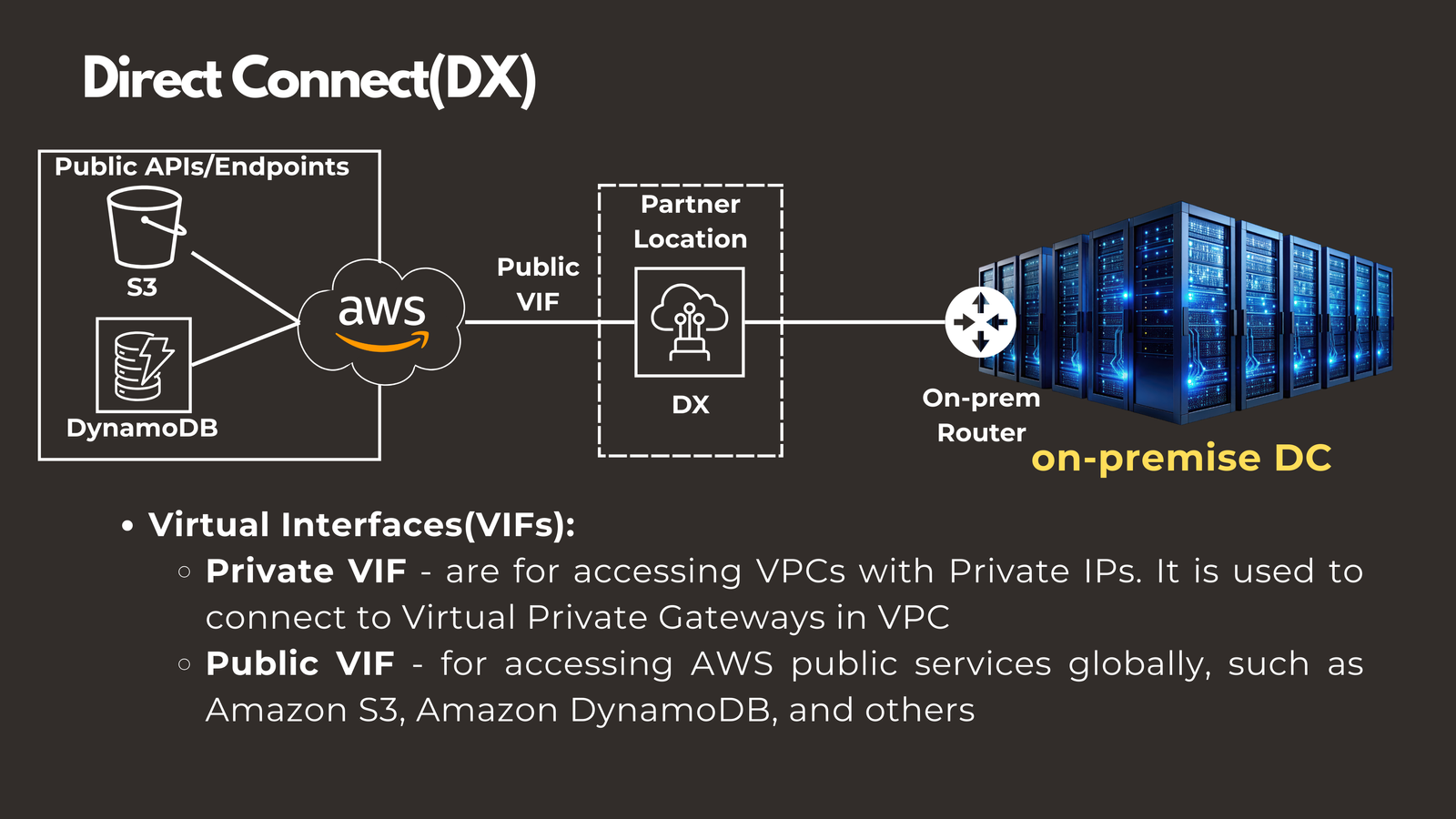
Public VIF: Provides access to AWS public services globally, including Amazon S3, DynamoDB, and other public endpoints.
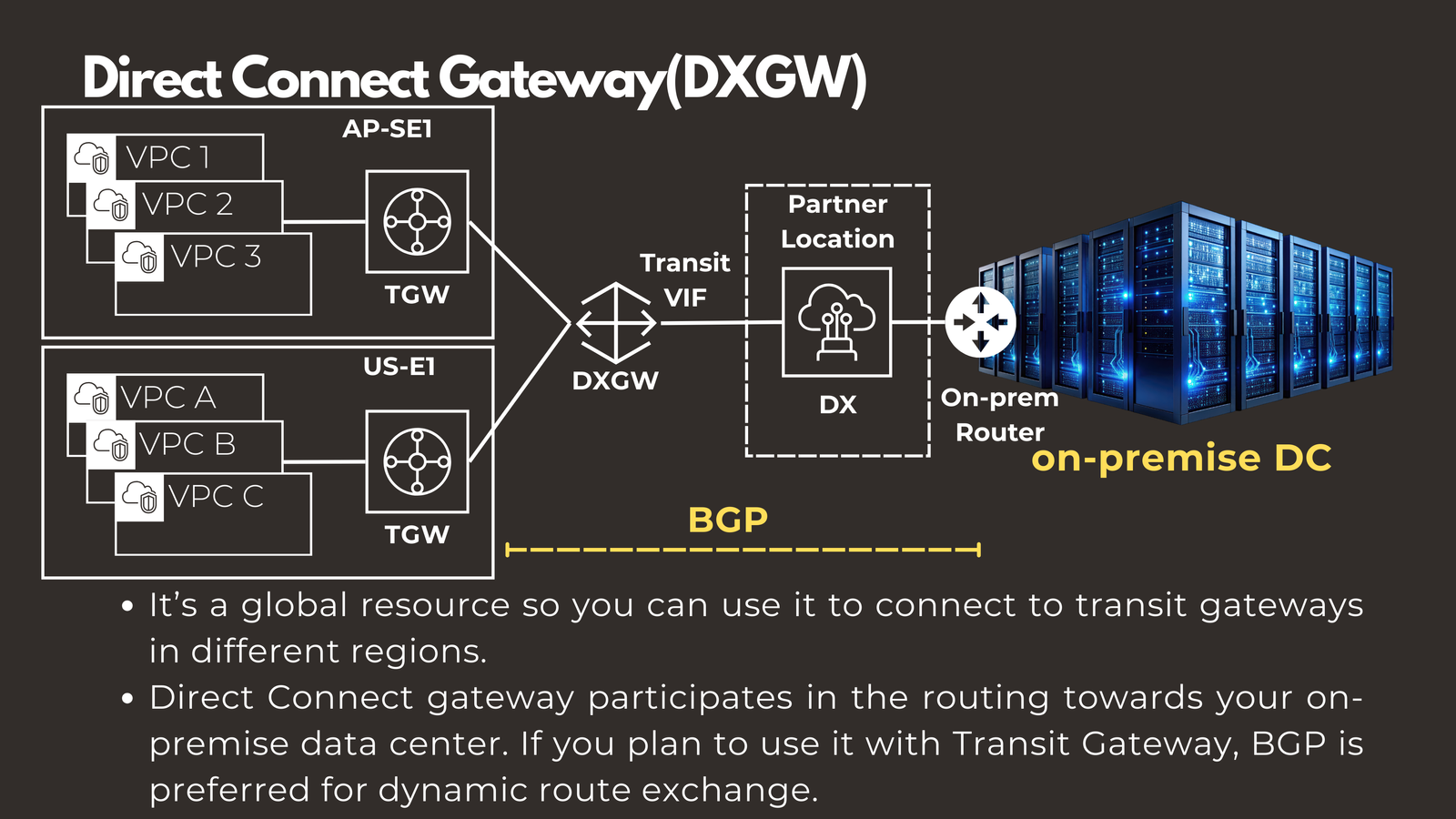
Transit VIF: Enables connectivity to Transit Gateways through a Direct Connect Gateway, combining the benefits of Direct Connect with the scalability of Transit Gateway.
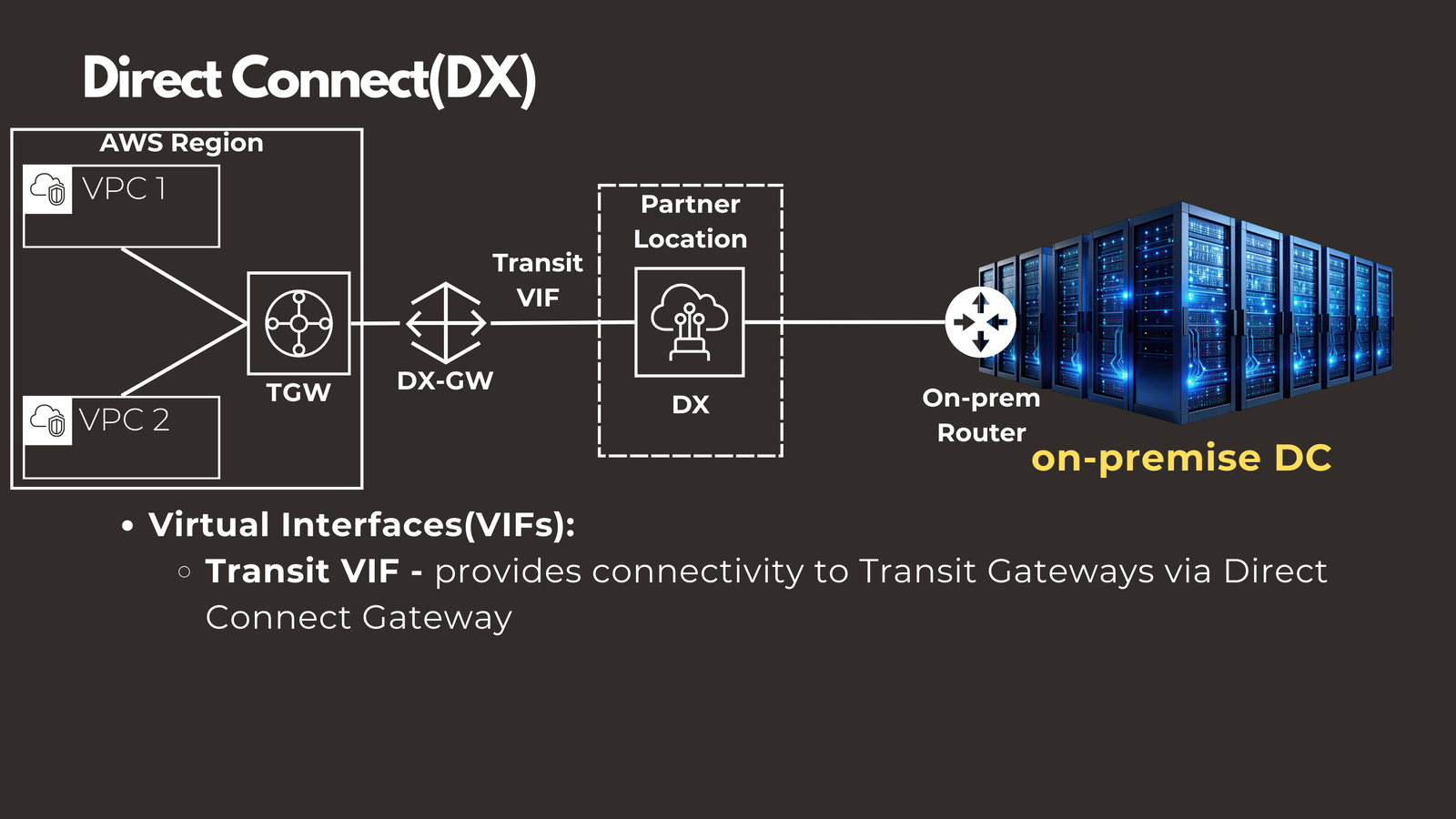
Direct Connect Gateway: Global Connectivity Made Simple
The Direct Connect Gateway is a global resource that extends the reach of a single Direct Connect connection to multiple VPCs across different AWS regions.
Why use Direct Connect Gateway:
- Connect one Direct Connect location to VPCs in multiple regions without provisioning separate Direct Connect connections
- Participate in routing decisions to your on-premises data center
- Support dynamic routing with BGP when used with Transit Gateway
- Connect to Virtual Private Gateways in different regions using Private VIFs
Routing considerations: When deploying Direct Connect Gateway with Transit Gateway, BGP is the preferred option for dynamic route exchange, ensuring optimal path selection and automatic failover capabilities.
Choosing the Right Connectivity Option
Selecting the appropriate connectivity solution depends on several factors:
For VPC-to-VPC connectivity:
- Use VPC Peering for simple, small-scale connections between a few VPCs
- Choose Transit Gateway when managing numerous VPCs or planning for significant growth
For hybrid connectivity:
- Use Site-to-Site VPN for cost-effective, encrypted connectivity when internet-based performance is acceptable
- Choose Direct Connect when you need consistent, high-performance, low-latency connectivity between on-premises and AWS
For global reach:
- Leverage Direct Connect Gateway to maximize the value of your Direct Connect investment across multiple regions
Conclusion
AWS provides flexible networking options to match your infrastructure requirements, whether you’re connecting VPCs within AWS or bridging cloud and on-premises environments. Starting with VPC Peering or Site-to-Site VPN offers quick wins for simple architectures, while Transit Gateway and Direct Connect provide the scalability and performance needed for enterprise-grade deployments.
Understanding these connectivity options helps you design network architectures that are both efficient and cost-effective, positioning your infrastructure to scale as your needs evolve.
Have questions about AWS VPC Connectivity? Check out the video on this link https://youtu.be/PeZtkPF5Mrc, drop a comment and let’s discuss!